
AI Artist & Tech Enthusiast
Urban Scenes Style Transfer: Complete Guide with AI Quali...
Urban photography captures the kinetic energy of modern life -- plazas crowded with pedestrians, mixed architecture layered across centuries, public spaces where glass and steel meet stone and greenery. Choosing the right art style for urban scenes style transfer determines whether your city photo becomes a compelling piece of art or a smeared mess of unreadable detail. We tested 116 art styles against urban scene photography using ArtFID quality scoring, and Romanticism emerged as the clear winner with the lowest ArtFID of 206.23. Upload your own city photograph to ArtRobot to see the difference for yourself.
Why Art Style Choice Matters for Urban Scenes Photography
Urban scene photographs are defined by their high-frequency visual profile. Plazas, public spaces, and mixed architectural environments pack an enormous amount of visual information into every frame -- hard geometric edges of buildings, irregular organic forms of trees and people, reflective surfaces of glass and water, repeating patterns of windows and balconies. This density of competing visual elements means that a style transfer algorithm must handle far more structural complexity than it would with a simple portrait or a single flower.
The way neural style transfer works is by aligning statistical distributions of feature maps between your content photograph and a reference painting. The Gram matrices extracted from deep neural network layers encode both the texture signature of an art style and the geometric structure of your photograph. When an art style's characteristic frequency range complements the high-frequency density of an urban scene, the algorithm can redistribute visual energy without destroying the recognizable layout of streets, buildings, and sky. When the frequencies clash, architectural lines dissolve, windows blur together, and the entire spatial logic of the city collapses.
"Contemporary art painting was Franz Kline (1910-62). He began in the late 1930s by painting city scenes in New York, and his later, almost wholly abstract black and white oil paintings were also inspired by the dynamism and violence of urban America. In them, he insisted, he was 'painting experiences': he was not creating formal abstractions, any more than he was painting 'bridge constructions or skyscrapers'. However, his work is often very evocative of just such urban configurations." -- History of Art, p. 614
We evaluated all 116 styles using ArtFID (Artistic Frechet Inception Distance), a composite metric that multiplies LPIPS (content preservation) by FID (style fidelity). Lower ArtFID scores indicate that the model preserves your photograph's spatial structure while successfully adopting the reference painting's aesthetic. Large-scale user studies confirm ArtFID correlates strongly with human judgment, making it the most reliable ranking method available for any given subject type.
Top 10 Art Styles for Urban Scenes Photos
We tested 116 art styles on urban_scenes photography using ArtFID — lower scores mean better results. Here are the top 10:
| Rank | Style | ArtFID | Stars | LPIPS | FID |
|---|---|---|---|---|---|
| 1 | Romanticism | 206.23 | 5 | 0.4369 | 142.53 |
| 2 | Morisot | 218.42 | 5 | 0.3884 | 156.32 |
| 3 | Expressionism | 236.80 | 5 | 0.2275 | 191.92 |
| 4 | Impressionism | 237.68 | 5 | 0.3285 | 177.90 |
| 5 | Turner | 245.11 | 5 | 0.4268 | 170.79 |
| 6 | Chagall | 247.41 | 5 | 0.2966 | 189.81 |
| 7 | Constable | 251.91 | 5 | 0.2255 | 204.55 |
| 8 | Dada | 251.94 | 5 | 0.2513 | 200.34 |
| 9 | Ernst | 251.94 | 5 | 0.2513 | 200.34 |
| 10 | High Renaissance | 257.47 | 5 | 0.5141 | 169.05 |
#1: Romanticism (ArtFID 206.23)
Romanticism dominates urban scene style transfer because its low-mid frequency, atmospheric brushwork wraps around complex cityscapes without competing with architectural geometry. The movement's emphasis on mood, dramatic light, and vast atmospheric perspective translates urban plazas into scenes that feel both monumental and emotionally charged -- hard edges of buildings soften just enough to become painterly while remaining fully legible. With the lowest FID score of 142.53 across all styles, Romanticism achieves exceptional style fidelity while preserving city structure.
#2: Morisot (ArtFID 218.42)
Berthe Morisot's loose, luminous Impressionist brushwork proves remarkably effective for urban scenes. Her characteristic technique of applying visible yet delicate strokes renders architectural surfaces with a shimmering quality that captures the way light plays across stone facades and glass windows. The FID of 156.32 ranks second-best overall, confirming strong stylistic transfer.
#3: Expressionism (ArtFID 236.80)
Expressionism's variable, often angular strokes align naturally with the hard geometric structures found in urban photography. Buildings, street signs, and structural beams gain dramatic emotional intensity through bold distortions and heightened color contrasts, while the style's inherently architectural character keeps city layouts recognizable. Notably, Expressionism achieves the lowest LPIPS of 0.2275 among the top three, indicating exceptional content preservation.
Before & After: Top Styles on Urban Scenes
See the transformations for yourself. Each row shows the original photograph, the style reference painting, and the AI result:
Romanticism — 5 Stars (ArtFID 206.23)
| Original Photo | Style Reference | AI Result |
|---|---|---|
 |
Romanticism style reference |  |
| Source photo | Romanticism | ArtFID: 206.23 |
The Romanticism transformation envelops the urban plaza in atmospheric warmth, softening hard concrete edges into painterly strokes while preserving the spatial depth between foreground figures and background architecture. The dramatic light characteristic of the Romantic tradition makes the city feel alive with theatrical grandeur.
Morisot — 5 Stars (ArtFID 218.42)
| Original Photo | Style Reference | AI Result |
|---|---|---|
 |
 |
 |
| Source photo | On the Balcony | ArtFID: 218.42 |
Morisot's delicate brushwork transforms the urban scene into a luminous, sun-dappled composition. Architectural surfaces shimmer with dappled color while maintaining clear spatial relationships between structures -- a balance of painterly softness and structural clarity that few other styles achieve.
Expressionism — 5 Stars (ArtFID 236.80)
| Original Photo | Style Reference | AI Result |
|---|---|---|
|
Expressionism style reference | 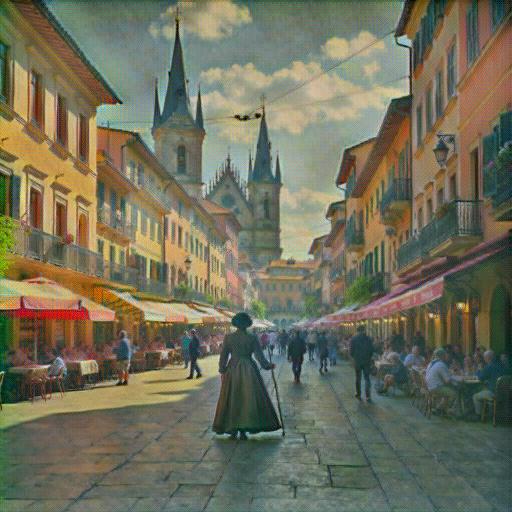 |
| Source photo | Expressionism | ArtFID: 236.80 |
The Expressionist treatment intensifies the emotional charge of the urban environment, amplifying contrast and pushing colors toward bold, saturated extremes. Building facades gain an almost confrontational energy while street-level details remain sharp and structurally intact, proving that dramatic stylistic distortion need not sacrifice legibility.
"The diversity of theory and practice and the number of younger talents committed to unremitting research in pictorial art are proof of a vigorous and original school of painting, the first in American history which has been independent of European influence and which has had, in turn, a significant effect on painting abroad." -- Art Through the Ages, p. 758
Styles to Avoid for Urban Scenes
Not every art style works well with urban_scenes photography. Based on ArtFID testing:
- Dore — ArtFID 516.78 (1 Star): The detailed engraving-like linework competes directly with urban architectural lines, creating a chaotic tangle of overlapping detail that obliterates spatial depth.
- Picasso — ArtFID 498.98 (2 Stars): Cubist fragmentation of geometric forms that are already geometric produces visual confusion -- buildings and streets become unreadable when fractured into competing angular planes.
- Veronese — ArtFID 488.11 (2 Stars): The heavy, ornamental brushwork and dark tonal range obscure the architectural clarity and spatial openness that make urban scenes visually compelling.
- Art Nouveau — ArtFID 485.62 (2 Stars): Organic, curvilinear decorative patterns fundamentally conflict with the hard geometric edges of urban architecture, dissolving structural logic into flowing ornamental noise.
- Durer — ArtFID 452.80 (2 Stars): The extremely fine crosshatching detail overwhelms the already information-dense surfaces of urban photography, resulting in muddy textures where individual elements lose definition.
Urban Scenes Photography Tips for Style Transfer
- Shoot during golden hour or blue hour for directional light that creates strong shadows along building facades -- styles like Romanticism and Turner amplify atmospheric light beautifully when your source photo already contains dramatic illumination.
- Include a clear foreground, middle ground, and background to give the style transfer algorithm distinct depth layers to work with. Urban plazas with people in the foreground, architectural detail in the middle, and sky in the background produce the most compelling results.
- Simplify your composition where possible by finding angles that reduce visual clutter. A single prominent building against open sky transfers more cleanly than a dense streetscape packed with competing signage and structures.
- Capture mixed textures -- stone walls, glass reflections, greenery, water features -- because styles like Impressionism and Morisot thrive on varied surface textures that give the algorithm diverse material to reinterpret.
- Use higher resolution source photos (at least 2000px on the long edge) since urban scenes contain fine architectural detail that lower-resolution images lose during the style transfer process, particularly with high-frequency styles like Pointillism.
How to Apply Art Styles to Urban Scenes Photos
Step 1: Choose Your Photo
Upload your urban scenes photograph to ArtRobot. Based on our ArtFID testing, Romanticism, Morisot, and Expressionism produce the best results.
Step 2: Select an Art Style
Browse the art style library and pick your preferred style. Check our Art Styles catalog for inspiration or use the comparison table above to choose based on quality scores.
Step 3: Download Your Art
Generate your styled image in seconds and download in multiple resolutions — from social media to print-ready 4K.
Try Urban Scenes Style Transfer Free on ArtRobot ->
FAQ
What is the best art style for urban scenes photography?
Based on ArtFID testing across 116 styles, Romanticism ranks #1 with an ArtFID of 206.23 for urban scenes. Its atmospheric, low-mid frequency brushwork wraps beautifully around complex cityscapes without destroying architectural geometry. Morisot (218.42) and Expressionism (236.80) follow as strong alternatives with distinct aesthetic approaches.
Why do some art styles work better for urban scenes photos?
Urban scenes have a high-frequency visual profile -- packed with hard edges, repeating patterns, and dense detail. Art styles that operate in lower or complementary frequency ranges (like Romanticism's atmospheric approach) can redistribute that visual energy into painterly effects without creating destructive interference. Styles that are also high-frequency and detail-heavy (like Dore at ArtFID 516.78) tend to clash with urban detail, producing muddy, unreadable results.
How do I choose the right style for my urban scenes photo?
Start with the ArtFID rankings in the table above -- lower scores mean better quality. For dramatic, moody cityscapes, try Romanticism or Turner. For vibrant, light-filled street scenes, Impressionism or Morisot work exceptionally well. For bold, emotionally intense urban art, Expressionism delivers striking results. You can also explore specific urban scenes photo effects for detailed comparisons.
What urban scenes photos produce the best style transfer results?
Photos with clear spatial depth (foreground, middle ground, background), directional lighting that creates visible shadows on building surfaces, and a mix of architectural and organic elements produce the strongest style transfer results. Avoid extremely cluttered compositions with overlapping signage or dense construction scaffolding, as these high-frequency details can overwhelm the style transfer algorithm regardless of which style you choose.
Can I apply multiple art styles to the same urban scenes photo?
Absolutely. One of the most revealing experiments is applying different styles to the same source photo to see how each movement reinterprets your city scene. Try comparing Romanticism for atmospheric drama against Expressionism for raw emotional intensity, or Impressionism for luminous color against Dada for chaotic energy. Upload your photo to ArtRobot and switch between styles instantly.
Related Guides
- Best Art Styles for Urban Scenes Photos
- Romanticism Style Transfer
- Expressionism Style Transfer
- Impressionism Style Transfer
- Dada Style Transfer
- High Renaissance Style Transfer
- Urban Scenes Romanticism Photo Effect
- Urban Scenes Expressionism Photo Effect
- Urban Scenes Impressionism Photo Effect
Try It Yourself
Romanticism scored the lowest ArtFID of 206.23 across all 116 styles we tested on urban scene photography -- but each of the top 10 styles brings a unique artistic vision to your city photos. Upload your own urban photograph and see which style speaks to you.
Try It Yourself
Transform your own photos into stunning paintings with 80+ artist styles. Free to start.