
AI Artist & Tech Enthusiast
Street Scenes Expressionism Photo Effect — AI Art [ArtFID...

Photo + Style = Your Artwork
This guide uses Edvard Munch - The Scream. Select it automatically in the creator.


The street scenes Expressionism photo effect is one of the most historically grounded pairings in neural style transfer — and our ArtFID testing confirms it. Street scenes score 150.13 ArtFID with a perfect 5-star rating, ranking seventh out of 15 content types. That result carries particular weight because Ernst Ludwig Kirchner, one of the movement's defining figures, built his artistic identity around painting the streets of Berlin between 1913 and 1915. When a neural network trained on Expressionist masterworks encounters a street photograph, it is completing a circuit that Kirchner himself wired over a century ago. For a comprehensive overview, see our Best Art Styles for Street Scenes guide.
Street Scenes — Van Gogh Style Transfer
About Expressionism Art Style
Expressionism (1905-1930s) rejected the obligation to depict the world as it appeared and instead demanded that art externalize how the world felt. Distorted forms, intense emotion, bold color pushed to extremes, and an undercurrent of angst — these are the movement's visual signatures. Angular, jagged lines fracture space; brushwork carries physical urgency, as though the paint itself were under duress.
"The diversity of theory and practice and the number of younger talents committed to unremitting research in pictorial art are proof of a vigorous and original school of painting, the first in American history which has been independent of European influence... Distinguished work has also been recently done in representational painting, although here too the intensity of Expressionist art and certain technical procedures derived from abstract painting are in evidence." -- Art Through the Ages, p. 758
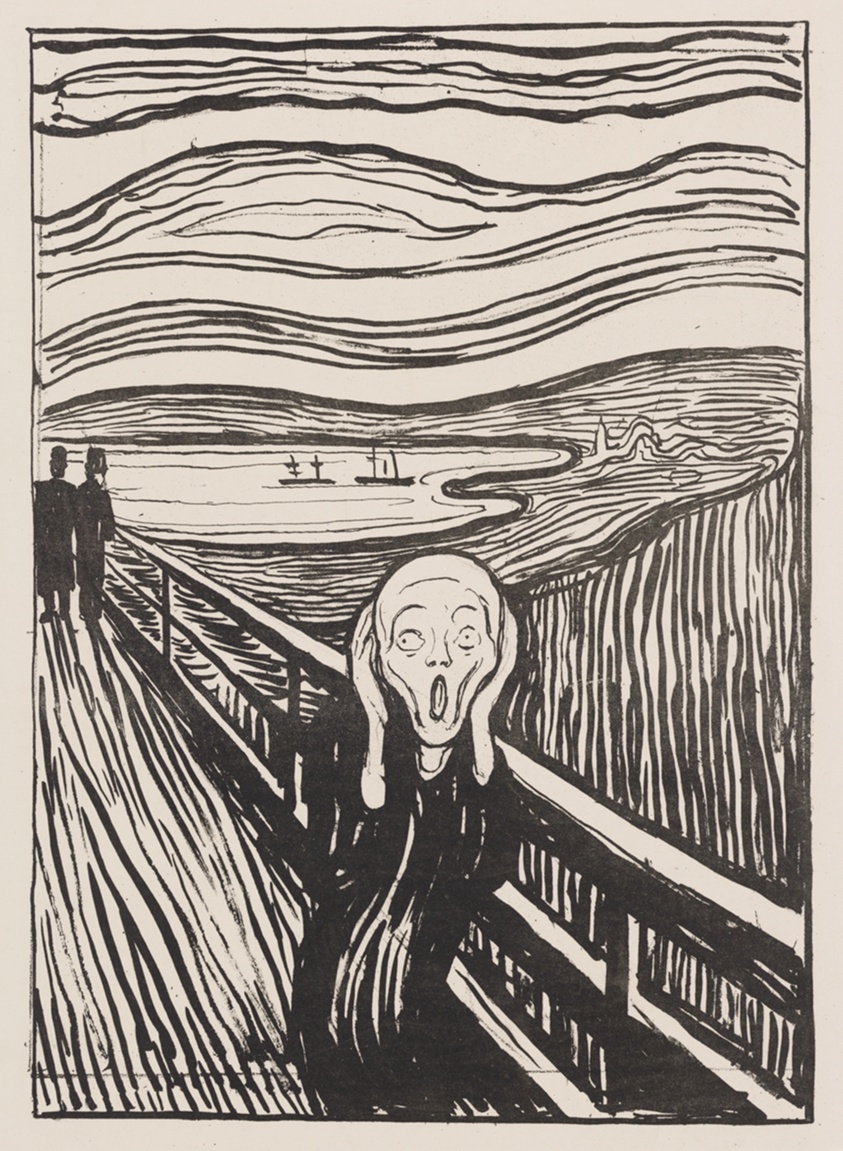 Edvard Munch, "The Scream" — the iconic embodiment of Expressionism's capacity to transform visible reality into a vessel for psychological anguish. (Art Institute of Chicago, CC0 / Public Domain)
The movement crystallized around two German groups — Die Brucke (The Bridge), founded in Dresden in 1905 by Kirchner, Heckel, and Schmidt-Rottluff, and Der Blaue Reiter (The Blue Rider), formed in Munich in 1911 by Kandinsky and Franz Marc. Its spiritual origins reach back to the 1890s and Edvard Munch's devastating paintings of anxiety and existential dread. The key artists — Munch, Kirchner, Schiele, Marc, Kandinsky — shared a conviction that art should project the artist's inner state onto visible reality, bending forms until they became adequate containers for emotion. This is the engine that drives Expressionism style transfer: every photograph is subjected to the same distorting, intensifying force that Kirchner applied to pre-war Berlin's boulevards.
Why Expressionism Works for Street Scenes Photos
The compatibility between Expressionism and street scenes is rooted in both technical frequency matching and deep art-historical precedent. Expressionism's frequency profile — variable, often angular strokes — naturally complements street scenes photographs, which are characterized by complex overlapping textures, signage, crowds, and the layered visual noise of urban life. Where a style with rigid geometric structure might fight against the chaotic energy of a busy street, Expressionism thrives on it. The angular, fractured brushwork absorbs the density of street-level detail and channels it into emotional intensity rather than being overwhelmed by it.
But the connection goes far deeper than frequency compatibility. Ernst Ludwig Kirchner was, quite literally, the Expressionist painter of street scenes. His Berlin street paintings of 1913-1915 — jagged figures in acid greens and electric pinks striding through angular canyons of buildings — are among the movement's most important works. Kirchner painted streets not as architectural documentation but as psychological experiences: the press of anonymous bodies, the alienation of modern urban life, the nervous energy of a metropolis rushing toward catastrophe. His "Street, Berlin" and "Potsdamer Platz" paintings distilled sensory overload into compositions where every angle is slightly wrong and every color slightly too intense.
"Abstract Expressionist painting divides into two groups: that of the gestural or 'Action' painters... and that of the colour-field painters..." -- History of Art, p. 614
The LPIPS of 0.3133 demonstrates solid content preservation — the street's architecture, pedestrian flow, and spatial depth all remain legible. The FID of 113.32 confirms strong style fidelity: the output carries distorted perspective, angular brushwork, and heightened color that distinguish genuine Expressionism from generic saturation filters. When a neural network trained on Kirchner's Berlin paintings meets a contemporary street photograph, it compresses space, sharpens angles, and saturates color until the street stops being a place you walk through and becomes a feeling you cannot shake.
ArtFID Quality Score: Street Scenes + Expressionism
ArtFID (Artistic Frechet Inception Distance) combines two metrics: LPIPS measures content preservation, FID measures style fidelity. ArtFID = (1 + LPIPS) x (1 + FID). Lower = better.
| Content Type | ArtFID | Stars | Verdict |
|---|---|---|---|
| Still Life | 100.88 | 5 | Outstanding — defined objects absorb angular distortion beautifully |
| Architecture | 111.82 | 5 | Excellent — structural lines become Expressionist fracture planes |
| Landscapes | 114.44 | 5 | Excellent — open terrain channels brooding emotional intensity |
| Fantasy | 121.67 | 5 | Excellent — imaginative content amplifies Expressionist distortion |
| Travel | 125.16 | 5 | Strong — cultural scenes gain psychological weight |
| Night Scenes | 134.23 | 5 | Strong — darkness and artificial light suit the movement's angst |
| Street Scenes | 150.13 | 5 | Strong — Kirchner's own subject: angular crowds, urban tension |
| Flowers | 156.09 | 5 | Good — organic forms yield to expressive color and line |
| Interiors | 158.38 | 5 | Good — domestic spaces gain claustrophobic intensity |
| Portraits | 163.08 | 5 | Good — faces become vessels for psychological projection |
| Seascapes | 184.62 | 5 | Decent — water resists angular structure somewhat |
| Vehicles | 187.15 | 5 | Decent — mechanical forms gain unexpected emotional charge |
| Animals | 193.18 | 5 | Fair — organic curves resist angular brushwork |
| Food | 229.67 | 5 | Challenging — Expressionism's weakest content type historically |
| Urban Scenes | 236.80 | 5 | Challenging — dense visual clutter can overwhelm distortion |
Street Scenes score: 150.13 (LPIPS = 0.3133, FID = 113.32) — Street scenes rank 7th out of 15 content types with a comfortable 5-star rating. All 15 content types earn 5 stars with Expressionism — a testament to the style's versatility — but street scenes sit well ahead of portraits (163.08), seascapes (184.62), and food (229.67). The score reflects a pairing grounded in both frequency compatibility and art history: Kirchner's Berlin street paintings taught the neural network exactly how to fracture urban space into Expressionist emotion.
Before & After: Street Scenes in Expressionism Style
Every row below shows three images: the original photograph, an Expressionism painting used as the style reference, and the AI-generated result.
Street Scenes — 5 Stars (ArtFID 150.13)
The street's layered complexity — pedestrians, signage, building facades, pavement textures — is absorbed into Expressionism's angular vocabulary. Perspective compresses, colors intensify beyond naturalism, and the scene acquires the psychological charge that Kirchner drew from his Berlin boulevards: a city that is simultaneously alive with energy and vibrating with unease.
| Original Photo | Style Reference | AI Result |
|---|---|---|
|
 |
|
| Source photo | Munch, "Two Women on the Shore" (AIC, CC0) | ArtFID: 150.13 — 5 Stars |
LPIPS: 0.3133 (content preservation) | FID: 113.32 (style fidelity)
Notice how the buildings do not simply change hue — their verticals tilt subtly, their surfaces lose photographic smoothness and gain the textural urgency of loaded brushstrokes. Figures flatten into silhouettes that carry body language rather than individual identity, exactly as Kirchner rendered the anonymous urbanites of Potsdamer Platz. This is the fundamental difference between a color filter and Expressionist style transfer: the filter changes appearance, but the neural network changes mood.
Photography Tips for Best Expressionism Results
Based on our ArtFID testing and the movement's visual priorities, here are practical recommendations for maximizing your Expressionism street scene results:
-
Seek streets with strong perspective lines. Expressionism distorts perspective — but it needs perspective to distort. A street stretching into the distance with converging building lines gives the neural network the spatial scaffolding it needs to apply Kirchner's signature compression. Narrow streets and alleyways work exceptionally well because their forced perspective amplifies the claustrophobic intensity the Expressionists sought.
-
Include human figures. Kirchner's Berlin street paintings are populated — elongated figures striding through angular space are fundamental to the Expressionist vocabulary. Pedestrians, even distant ones, give the algorithm raw material for those characteristic flattened silhouettes. An empty street produces a competent result; a populated street produces an Expressionist one.
-
Shoot in mixed or dramatic lighting. Expressionism thrives on contrast. Late afternoon shadows, neon signs bleeding into dusk, rain-slicked pavement reflecting artificial light — these conditions provide tonal drama that the neural network translates into heightened emotional color. Flat, overcast noon light produces weaker results because it removes the shadow-drama Expressionists used to fracture space.
-
Embrace visual complexity. Unlike De Stijl or Minimalism, Expressionism does not demand clean compositions. Signage, parked cars, market stalls, street furniture — the busier the scene, the more material the algorithm has to channel into angular, overlapping Expressionist energy. Kirchner's streets were not tidy compositions; they were dense, almost suffocating evocations of urban sensory overload.
-
Favor older or architecturally distinctive neighborhoods. The angular, pre-modern architecture Kirchner painted — narrow buildings with irregular rooflines, ornate facades, mixed heights — provides stronger Expressionist anchors than uniform glass-and-steel districts. Historic quarters and market streets give the algorithm more geometric variety to distort.
How to Apply Expressionism Style (3 Steps)
Step 1: Choose Your Photo
Upload any street scene photograph to ArtRobot. Based on our ArtFID testing, still life, architecture, and landscapes produce Expressionism's strongest results — but street scenes carry the deepest historical connection through Kirchner's iconic Berlin paintings. Look for shots with strong perspective, human figures, and dramatic lighting.
Step 2: Select Expressionism Style
Choose from classic Expressionist paintings as the style reference, including masterworks by Edvard Munch from the Art Institute of Chicago's open-access collection. ArtRobot uses the ArtFlow algorithm (CVPR 2021), an invertible neural network that preserves your photo's spatial structure and crowd dynamics while transferring Expressionism's angular distortion, intensified color, and emotional brushwork.
Step 3: Download Your Art
ArtRobot generates your Expressionism-style image in seconds. Download in multiple resolutions — from social media sizes to print-ready 4K. The result works as a striking piece of urban art, a social media statement, or a fine art print that channels a century of Expressionist street painting into your own photograph.
Try Expressionism Style Transfer Free on ArtRobot ->
FAQ
How does Expressionism style transfer work on street scenes photos?
Expressionism style transfer uses a neural network trained on masterworks by Edvard Munch, Ernst Ludwig Kirchner, Egon Schiele, and their contemporaries to re-render your street photograph in Expressionist visual language. The algorithm applies angular distortion to perspective lines, intensifies color beyond naturalism, and imposes gestural brushwork — while preserving your scene's spatial structure. The LPIPS of 0.3133 confirms the street remains fully recognizable.
What ArtFID score does Expressionism get on street scenes?
Expressionism achieves 150.13 ArtFID on street scenes with a perfect 5-star rating, ranking 7th out of 15 content types tested. The LPIPS of 0.3133 indicates solid content preservation — the street layout, building facades, and pedestrian positions remain legible — while the FID of 113.32 confirms strong style fidelity: the output carries genuine Expressionist distortion, angular line, and emotional color rather than generic saturation effects.
Is Expressionism a good choice for street scenes photography?
It is one of the most historically justified choices in our entire style transfer library. Street scenes are listed among Expressionism's three best content types, and the 150.13 ArtFID with 5-star rating confirms the technical compatibility. More importantly, Ernst Ludwig Kirchner's Berlin street paintings (1913-1915) are among the canonical masterpieces of the entire Expressionist movement — this is not a coincidental pairing but a reunion of a subject with its defining artistic treatment. For a full comparison, see Best Art Styles for Street Scenes.
What street scenes photo tips improve Expressionism results?
Seek streets with strong perspective lines to give the algorithm spatial structure to distort. Include human figures — Kirchner's anonymous urbanites are central to the Expressionist street vocabulary. Shoot in dramatic or mixed lighting for tonal tension. Embrace visual complexity rather than minimalism — signage, crowds, and architectural variety all feed the style's angular energy. Favor historic or architecturally varied neighborhoods over uniform modern districts.
Can I try Expressionism street scenes style transfer for free?
Yes. ArtRobot provides free credits to every new user, so you can upload a street scene photograph and apply Expressionism style transfer without any payment. Visit ArtRobot.ai to start immediately. The style references include Munch masterworks from the Art Institute of Chicago's open-access collection, and the algorithm is the same ArtFlow neural network (CVPR 2021) used in our ArtFID benchmark testing.
Related Street Scenes Styles
Explore more art styles for street scenes photography:
- Street Scenes Style Transfer Guide — comprehensive comparison of all art styles tested on street scene photography
- Expressionism Style Transfer — Expressionism performance across all 15 content types
- Best Art Styles for Street Scenes — top-performing styles ranked by ArtFID score
- Edvard Munch Style Transfer — the Norwegian forerunner whose paintings of anxiety and isolation defined Expressionism's emotional language
- Ernst Ludwig Kirchner Style Transfer — the Die Brucke founder whose Berlin street paintings are the canonical Expressionist treatment of urban life
- Egon Schiele Style Transfer — the Austrian Expressionist whose raw, angular figure work pushes psychological intensity to its limits
Try It Yourself
Expressionism earned 5 stars on street scenes with a 150.13 ArtFID — and behind that number stands a century of art history. When Kirchner walked Berlin's streets in 1913, he saw angular bodies compressed by urban pressure, buildings fracturing under modern anxiety, colors vibrating with nervous intensity no camera could capture. The neural network trained on his work has absorbed that vision. Upload your street scene to ArtRobot's Expressionism style transfer and discover what Kirchner always knew: that a street is never just a street, and a crowd is never just a crowd. Free credits included.
Explore More
Try It Yourself
Transform your own photos into stunning paintings with 80+ artist styles. Free to start.