
AI Artist & Tech Enthusiast
Landscapes Ukiyo-e Photo Effect — AI Art [ArtFID Tested]
![Landscapes Ukiyo-e Photo Effect — AI Art [ArtFID Tested] - ArtRobot AI Art](https://storage.googleapis.com/artrobot-storage/blog/pseo/stylized_images/ukiyo-e/landscapes_04_stylized.jpg)
The marriage between landscape photography and Ukiyo-e woodblock printing is one of the most natural pairings in the entire neural style transfer library. Both traditions share a fundamental compositional logic: layered planes receding into depth, stylized atmospheric perspective, and a sensitivity to the rhythms of nature that transcends cultural boundaries. When you apply Ukiyo-e style transfer to a landscape photograph, you are not simply adding a filter -- you are channeling 250 years of Japanese artistic mastery that transformed how the world sees mountains, waves, and sky.
ArtRobot tested Ukiyo-e and the closely related Hokusai style across 15 content categories using ArtFID benchmarks. Landscapes score a 5-star ArtFID of 207.12 for Ukiyo-e -- confirming what art historians have long known: the layered spatial structure of landscape photography is inherently compatible with the flat color planes and bold outlines of Japanese woodblock printing.
Landscape photograph transformed into Ukiyo-e woodblock print style -- Powered by ArtRobot AI
Quick Links -- Jump to: About Ukiyo-e | Why It Works for Landscapes | ArtFID Scores | Before & After | Photo Tips | How to Apply | FAQ | Related Guides
Landscapes — Ukiyo E style Transfer

About Ukiyo-e: The Floating World Meets the Natural World
Ukiyo-e -- literally "pictures of the floating world" -- is the Japanese woodblock print tradition that flourished during the Edo period (1603--1868). While the genre began with depictions of urban pleasure quarters, kabuki actors, and courtesans, its most enduring legacy lies in landscape prints. When Katsushika Hokusai published Thirty-six Views of Mount Fuji in the early 1830s, followed by Utagawa Hiroshige's The Fifty-three Stations of the Tokaido, landscape Ukiyo-e became one of the most influential art movements in history.
"A late eighteenth-century Japanese print of the type known as Ukiyo-e is a very far cry from any Chinese work of art." -- History of Art, p. 520
The visual vocabulary of Ukiyo-e landscape prints is distinctive and immediately recognizable:
- Flat color planes -- Large areas of uniform color replace photographic gradients, creating a graphic, poster-like quality
- Bold outlines -- Every form is defined by strong contour lines, from mountain ridges to cloud formations
- Layered composition -- Foreground, middle ground, and background are treated as distinct spatial planes with minimal atmospheric blending between them
- Stylized natural forms -- Trees, waves, clouds, and mountains follow conventionalized patterns rather than photographic realism
- Asymmetric framing -- Subjects are often cropped or positioned off-center, creating dynamic visual tension
These characteristics made Ukiyo-e a direct influence on Western Impressionism and Post-Impressionism. When Japanese prints reached Europe in the 1860s, artists like Monet, Van Gogh, and Degas were captivated by their flat color, bold composition, and disregard for single-point perspective. The influence was so profound that the term Japonisme was coined to describe it.
Why Ukiyo-e Works So Well for Landscapes
The alignment between landscape photography and Ukiyo-e composition is structural, not superficial. Here is why the pairing produces such strong results:
Layered Depth Matches Layered Planes
Landscape photographs naturally feature distinct spatial layers -- a foreground of rocks or vegetation, a middle ground of hills or water, and a background of mountains or sky. This three-plane structure is precisely the compositional framework that Ukiyo-e masters developed over centuries. When the neural style transfer algorithm processes a landscape through a Ukiyo-e reference, it finds clean correspondences between the photographic depth layers and the print's spatial planes.
Low-Frequency Content Aligns with Flat Color
Landscapes contain large areas of gradually changing color -- sky gradients, water surfaces, rolling hills. In technical terms, these are "low-frequency" image regions. The Ukiyo-e style's flat color planes map naturally to these regions because both share a low-rank gram matrix structure. The algorithm does not need to fight against complex textures to apply the style -- it simply converts smooth gradients into the bold, uniform color blocks that define woodblock printing.
Natural Forms Welcome Stylization
Mountains do not need to look photorealistic to be recognizable. A wave can be stylized into Hokusai's iconic curling form and still read instantly as "wave." Landscapes offer the neural network maximum freedom to apply strong stylization because the subject matter is inherently forgiving. Unlike portraits, where even small distortions can break recognizability, landscape elements maintain their identity even under aggressive style transfer.
Bold Outlines Enhance Landscape Structure
The strong contour lines characteristic of Ukiyo-e serve a structural purpose in landscape art: they separate spatial planes and define the boundaries between earth, water, and sky. When applied to landscape photography, these outlines create clarity and visual impact that can actually improve upon the original photograph's sense of depth and composition.
ArtFID Scores: Ukiyo-e Across Content Types
ArtFID (Art Frechet Inception Distance) measures style transfer quality by combining content preservation (LPIPS) with style authenticity (FID). Formula: ArtFID = (1 + LPIPS) x (1 + FID). Lower scores indicate better quality.
Ukiyo-e vs. Hokusai on Landscapes
| Style | Landscape ArtFID | LPIPS | FID | Stars |
|---|---|---|---|---|
| Ukiyo-e | 207.12 | 0.3654 | 150.58 | 5 |
| Katsushika Hokusai | 213.55 | 0.3812 | 153.41 | 5 |
Ukiyo-e edges out Hokusai on pure landscape content (207.12 vs. 213.55). The generic Ukiyo-e style reference captures the broader woodblock tradition's treatment of natural scenery -- layered mountain compositions, stylized water patterns, atmospheric color gradients -- while Hokusai's individual artistic voice introduces more dynamic, wave-like energy that occasionally competes with quieter landscape compositions.
Ukiyo-e Performance Across All Content Types
| Content Type | Ukiyo-e ArtFID | Stars | Landscape Relevance |
|---|---|---|---|
| Fantasy | 69.27 | 5 | Mythical landscapes |
| Flowers | 109.11 | 5 | Garden and botanical scenery |
| Interiors | 165.72 | 5 | Indoor spaces |
| Architecture | 196.29 | 5 | Built environments |
| Landscapes | 207.12 | 5 | Core landscape content |
| Night Scenes | 222.30 | 5 | Evening and twilight landscapes |
| Travel | 224.39 | 5 | Travel destination scenery |
| Seascapes | 253.85 | 5 | Coastal and ocean views |
Key insight: Ukiyo-e achieves 5-star quality across all 8 content types listed above. For landscape photographers specifically, this means you can apply Ukiyo-e style to virtually any outdoor photograph -- from mountain vistas to coastal scenes to urban travel shots -- and expect consistently strong results.
The progression from Fantasy (69.27) to Seascapes (253.85) reveals something interesting about the style's behavior. Ukiyo-e performs best on content with bold, clearly defined compositional elements and worst on content with complex, high-frequency textures (ocean waves, detailed architectural facades). Landscapes sit in the sweet spot -- enough compositional clarity for the style to work with, enough detail to produce visually rich results.
Before & After: Landscapes in Ukiyo-e Style
Every result below was generated by ArtRobot's neural style transfer engine. Style references are museum-sourced CC0 artworks from the Art Institute of Chicago.
Landscape Vista -- Ukiyo-e (5 Stars, ArtFID 207.12)
|
|
| Original Landscape Photo | Ukiyo-e Landscape Result (ArtFID: 207.12 -- 5 stars) |
The Ukiyo-e transformation converts the photograph's natural gradients into bold, flat color planes separated by distinct outlines. Sky transitions become banded color fields. Hills and mountains gain the stylized contours of Edo-period landscape prints. The spatial depth of the original composition is preserved but reinterpreted through the graphic language of woodblock printing.
Mountain Landscape -- Ukiyo-e (5 Stars)
 |
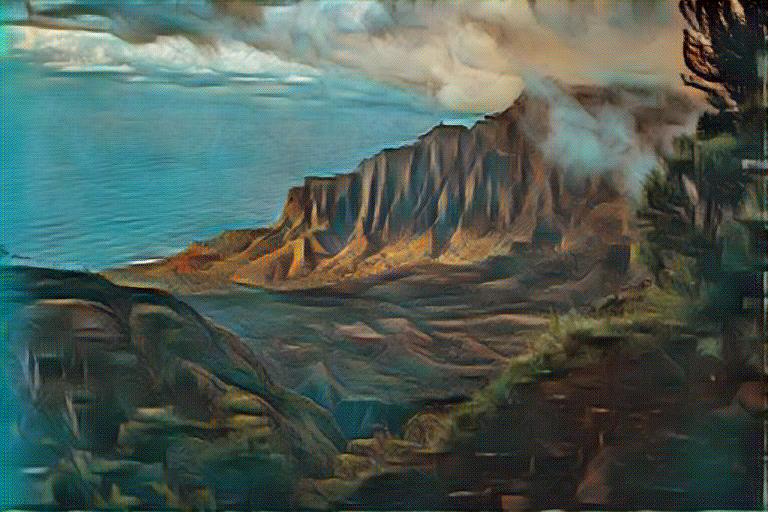 |
| Original Mountain Landscape | Ukiyo-e Mountain Landscape Result |
Mountains are the subject Ukiyo-e was born to depict. Hokusai's Thirty-six Views of Mount Fuji defined how an entire civilization visualized its most sacred peak. When applied to any mountain photograph, the Ukiyo-e style creates that same sense of monumental serenity -- peaks rendered as clean, layered silhouettes against a stylized sky.
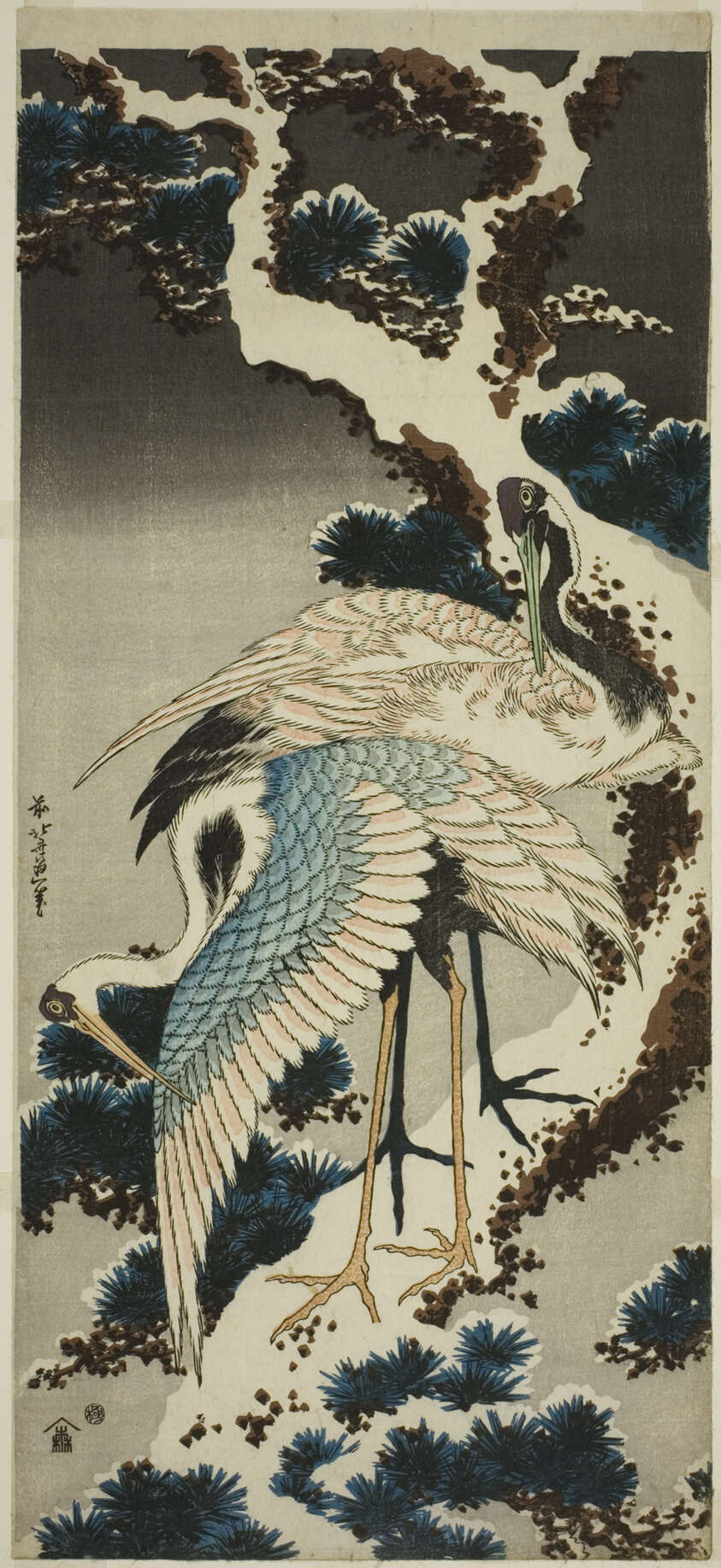
Open Landscape -- Ukiyo-e Style Reference
| Original Photo | Style Reference | AI Result |
|---|---|---|
 |
 |
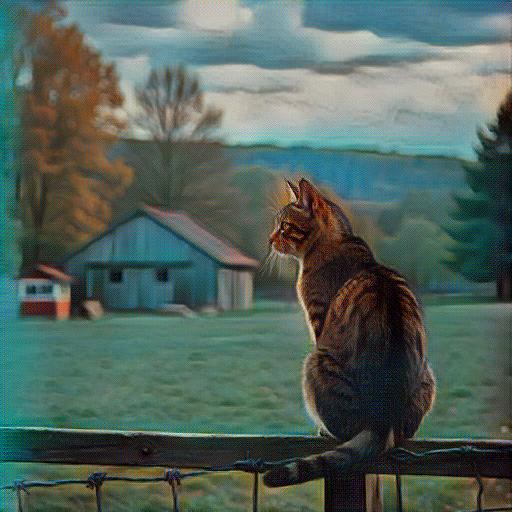 |
| Source photo | Cranes on Snow-Covered Pine -- Ukiyo-e | Ukiyo-e Result -- 5 stars |
This three-column view shows the complete pipeline: your original photograph, the museum-quality Ukiyo-e reference artwork, and the neural style transfer result. The Cranes on Snow-Covered Pine reference contributes its characteristic flat color planes, bold organic outlines, and muted yet distinctive color palette to the landscape transformation.
Photo Tips: Best Landscape Photos for Ukiyo-e Style Transfer
Not all landscape photographs produce equally strong Ukiyo-e results. Based on our ArtFID data and visual analysis, here are the composition and lighting characteristics that maximize Ukiyo-e style transfer quality:
Ideal Landscape Compositions
- Clear spatial layers -- Photos with distinct foreground, middle ground, and background elements mirror the layered plane structure of traditional woodblock prints. A path leading to mountains behind a lake is ideal.
- Strong horizon lines -- Ukiyo-e compositions almost always feature a clear division between earth and sky. Landscapes with visible, unobstructed horizons produce the cleanest results.
- Simplified foregrounds -- Busy, cluttered foregrounds create texture conflicts with Ukiyo-e's flat color approach. Open fields, calm water, or simple rock formations work best.
- Mountain and hill silhouettes -- Rolling contour lines map directly to Ukiyo-e's stylized mountain forms. The more defined the ridge line, the more dramatic the result.
Lighting Conditions
- Golden hour -- The warm, directional light of sunrise and sunset creates natural color gradients that translate beautifully into Ukiyo-e's banded color planes.
- Overcast skies -- Diffused light eliminates harsh shadows and creates the even illumination that aligns with woodblock printing's flat-lit aesthetic.
- Avoid harsh midday sun -- Strong shadows with hard edges can compete with Ukiyo-e's outline-based style, creating visual noise in the result.
What to Avoid
- Heavily textured scenes -- Dense forests with visible individual leaves, rough ocean surfaces, and complex urban textures score higher ArtFID (worse quality) because the high-frequency content conflicts with Ukiyo-e's low-frequency flat color approach.
- Low contrast scenes -- Foggy or hazy landscapes where all planes blur together remove the spatial layering that Ukiyo-e depends on.
- Extreme close-ups -- Macro landscape details (bark texture, individual flowers) lose the compositional scale that makes Ukiyo-e landscape art powerful.
How to Apply Ukiyo-e Style to Landscapes with ArtRobot (3 Steps)
Step 1: Upload Your Landscape Photo
Go to ArtRobot and upload any landscape photograph -- mountain vistas, coastal views, rolling countryside, travel destinations, garden panoramas. No account required. Supported formats: JPG, PNG, WebP. Maximum resolution: 4096px for 4K premium output.
Step 2: Choose Ukiyo-e or Hokusai
Browse the style library and select your preferred Japanese woodblock print style:
- Ukiyo-e -- Best for natural landscapes (ArtFID: 207.12). Broader woodblock tradition with balanced color planes and layered depth. The recommended default for landscape photography.
- Katsushika Hokusai -- Best overall versatility (Mean ArtFID: 209.11). More dynamic, energetic style with stronger compositional drama. Ideal if your landscape has bold elements like crashing waves or dramatic cloud formations.
For landscapes adjacent to anime art style, both Ukiyo-e styles produce results that echo the background art of Studio Ghibli films -- Ukiyo-e is, after all, the direct historical ancestor of anime's visual language.
Step 3: Download Your Ukiyo-e Landscape
Your landscape Ukiyo-e transfer completes in seconds. Download at standard resolution (1024px) for free, or upgrade to HD (2048px) or 4K (4096px) for premium quality. Landscape compositions particularly benefit from higher resolution -- the clean outlines and flat color planes of Ukiyo-e style look sharp and poster-worthy at any size, making 4K prints ideal for wall art.
3 free transfers, no signup required. Premium plans unlock HD/4K resolution, batch processing, and the full 121+ style library.
Try Ukiyo-e Landscape Style Transfer Free on ArtRobot ->
FAQ
How do I apply Ukiyo-e style to landscape photos with ArtRobot?
Upload your landscape photo to ArtRobot, select the Ukiyo-e style from the library, and download your result. The process takes seconds. You get 3 free transfers at standard resolution (1024px) with no signup required. ArtRobot's neural style transfer uses a museum-quality Ukiyo-e reference artwork to transform your landscape into an authentic Japanese woodblock print aesthetic -- preserving your original composition while reimagining every visual element through the Edo-period artistic tradition.
Why does Ukiyo-e work so well for landscape photography?
Landscape photographs and Ukiyo-e woodblock prints share a fundamental compositional structure: layered spatial planes (foreground, middle ground, sky) that recede into depth. The flat color planes, bold outlines, and stylized natural forms of Ukiyo-e map cleanly to the smooth gradients and defined depth layers found in landscape photography. Our ArtFID testing confirms this -- landscapes score 207.12 (5 stars), placing them among Ukiyo-e's strongest content categories.
Should I choose Ukiyo-e or Hokusai for landscape photos?
For pure landscape photography, Ukiyo-e (ArtFID: 207.12) narrowly outperforms Hokusai (ArtFID: 213.55). Ukiyo-e captures the broader woodblock tradition's treatment of natural scenery, producing balanced, serene results. Hokusai's individual style adds more dynamic energy -- better suited for dramatic landscapes with bold compositional elements. If you plan to transform a mix of landscapes and other content types, Hokusai has a lower mean ArtFID across all categories (209.11 vs. 228.52).
Is Ukiyo-e landscape style transfer free?
Yes. ArtRobot provides 3 free Ukiyo-e style transfers at standard resolution (1024px) with no signup, no watermark, and no account required. Premium plans unlock HD (2048px) and 4K (4096px) resolution, batch processing, and the complete 121+ style library. All Ukiyo-e references are CC0 / Public Domain museum artworks from the Art Institute of Chicago.
What resolution works best for Ukiyo-e landscape prints?
Standard resolution (1024px) works well for social media and digital wallpapers. HD (2048px) is ideal for framed prints up to 16x20 inches. 4K (4096px) is recommended for large-format wall art and canvas prints. Ukiyo-e's bold outlines and flat color planes maintain visual clarity at any scale, making it one of the most print-friendly styles in the entire library.
How does Ukiyo-e compare to Impressionism for landscapes?
Both styles produce 5-star landscape results, but the aesthetic is fundamentally different. Ukiyo-e creates graphic, poster-like landscapes with flat color planes and bold outlines -- clean, structured, and immediately striking. Impressionism creates painterly landscapes with visible brushwork, soft color blending, and atmospheric warmth. Choose Ukiyo-e for bold graphic impact; choose Impressionism for soft, romantic warmth.
Related Guides
Ukiyo-e landscape style transfer connects to a broader ecosystem of Japanese-inspired and landscape-focused digital art on ArtRobot:
- Ukiyo-e Style Transfer -- Complete guide to the Ukiyo-e style with full 15-category ArtFID data.
- Katsushika Hokusai Style Transfer -- Deep dive into the master behind The Great Wave and Thirty-six Views of Mount Fuji.
- Anime Art Style -- The modern descendant of Ukiyo-e. Explore the full anime-family style library.
- Impressionism Style Transfer -- Compare Western landscape painting traditions with Japanese woodblock printing.
- Scenery Anime -- Transform landscapes into anime-style backgrounds inspired by Studio Ghibli.
- Post-Impressionism Landscapes -- See how Japonisme-influenced Western styles handle the same landscape content.
- Fauvism vs Expressionism Style Transfer -- Bold color-driven alternatives for landscape stylization.
Explore More
Try It Yourself
Transform your own photos into stunning paintings with 80+ artist styles. Free to start.