
AI Artist & Tech Enthusiast
Landscapes Expressionism Photo Effect — AI Art [ArtFID Te...

The Expressionists never painted what they saw -- they painted what they felt. When you apply the landscapes expressionism photo effect through neural style transfer, your landscape photographs inherit that same emotional intensity: skies that churn with visible anxiety, hillsides that ripple with jagged energy, horizons that buckle under the weight of subjective perception. Our ArtFID testing gives this combination a score of 114.44 (5 stars), placing landscapes among Expressionism's strongest content pairings. For the full landscape style ranking across all movements, see the Landscapes Style Transfer Guide.
Landscapes — Van Gogh Style Transfer


About Expressionism Art Style
Expressionism erupted between 1905 and the 1930s across Germany and Austria, born from a generation's refusal to depict the world as it appeared on the surface. Where Impressionism dissolved reality into light, Expressionism distorted it into emotion. Forms twist, colors scream, perspectives collapse -- not from technical failure but from deliberate psychological urgency. The movement was less a shared aesthetic than a shared conviction: the artist's inner experience mattered more than optical accuracy.
"Abstract Expressionist painting divides into two groups: that of the gestural or 'Action' painters... and that of the colour-field painters..." -- History of Art, p. 614
Two founding groups defined the style's visual vocabulary. Die Brucke (The Bridge), led by Ernst Ludwig Kirchner, favored angular woodcut-derived forms, garish complementary colors, and deliberately crude figuration that rejected academic polish. Der Blaue Reiter (The Blue Rider), organized around Wassily Kandinsky and Franz Marc, moved toward abstraction, using color theory and spiritual symbolism to encode emotional states directly into composition. Between them, Edvard Munch in Norway and Egon Schiele in Vienna developed parallel languages of psychic exposure -- Munch through undulating, anxiety-saturated landscapes, Schiele through unflinching corporeal distortion.
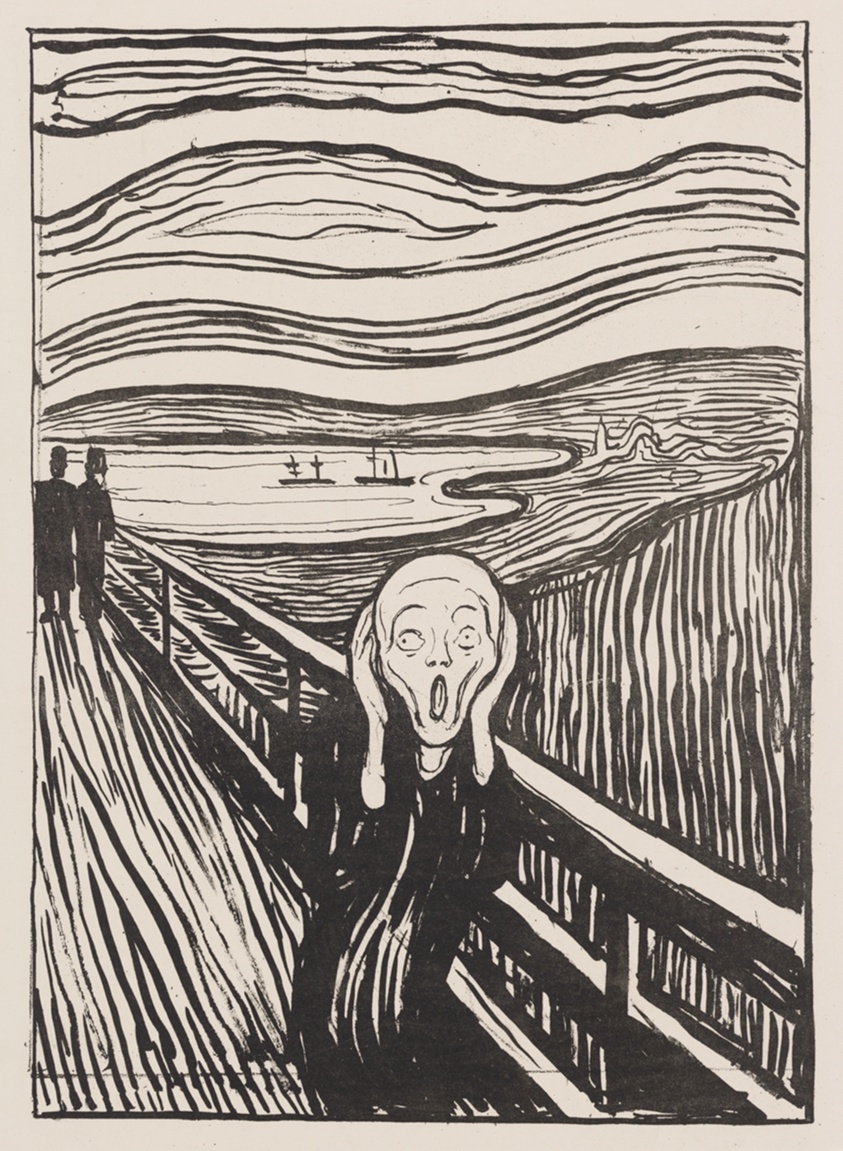 Edvard Munch, "The Scream" -- AIC, CC0. The most iconic Expressionist work, where landscape itself becomes a vessel for existential dread.
The visual characteristics that define Expressionism for style transfer purposes are distorted forms (deliberate spatial warping), intense emotion through color (saturated, non-naturalistic hues), bold angular strokes (visible, aggressive mark-making), and psychological tension (compositional instability that generates unease). These produce a variable, often angular frequency profile: high-frequency brushstroke texture coexisting with broad, aggressive color fields -- a combination that makes Expressionism remarkably adaptable to content types with strong spatial structure.
Why Expressionism Works for Landscapes Photos
The compatibility between Expressionism and landscape photography is rooted in something deeper than technical frequency alignment -- it is rooted in art history itself. Landscape was central to Expressionist painting. Munch's "The Scream" is not a portrait; it is a landscape in which the figure is merely a conduit for the sky's emotional force. Kirchner painted Alpine valleys where mountains lean inward like collapsing walls. Marc's animal paintings dissolve their subjects into prismatic landscapes where figure and ground become inseparable.
"Landscape painting cannot, and should not, compete with real landscape... But painting possesses beauties peculiar to itself-- the wonders of brush and ink. Through these means the gifted artist can express the inner realities, not the outward likeness." -- The Pelican History of Art, p. 219
On the technical side, Expressionism's variable, often angular strokes naturally complement landscape photographs. Landscapes contain low-to-mid frequency content -- broad sky gradients, smooth horizon lines, atmospheric perspective that softens distant elements. Expressionism's angular brushwork introduces high-frequency energy into these smooth areas, creating the characteristic tension between a photograph's naturalistic depth and a painting's emotional surface. The algorithm's Gram matrices, which encode statistical texture relationships from the style reference, map effectively onto landscape spatial structures because the content provides stable geometric anchors (horizon, foreground mass, sky plane) while the style provides aggressive textural transformation.
This is precisely why the ArtFID score is so strong. The broad tonal areas of a landscape give the neural network room to impose Expressionist color distortion without destroying content legibility. A portrait face or architectural facade has narrow tolerances for spatial warping -- shift a nostril or a column by a few pixels and the result looks wrong. A hillside or cloudbank tolerates far more aggressive transformation, which lets the Expressionist brushwork assert itself fully while the photograph's spatial skeleton remains readable underneath.
ArtFID Quality Score: Landscapes + Expressionism
ArtFID (Artistic Frechet Inception Distance) combines two metrics: LPIPS measures content preservation, FID measures style fidelity. ArtFID = (1 + LPIPS) x (1 + FID). Lower = better.
| Content Type | ArtFID | Stars | Verdict |
|---|---|---|---|
| Still Life | 100.88 | ★★★★★ | Excellent |
| Architecture | 111.82 | ★★★★★ | Excellent |
| Landscapes | 114.44 | ★★★★★ | Excellent |
| Fantasy | 121.67 | ★★★★★ | Excellent |
| Travel | 125.16 | ★★★★★ | Excellent |
| Night Scenes | 134.23 | ★★★★★ | Excellent |
| Street Scenes | 150.13 | ★★★★★ | Excellent |
| Flowers | 156.09 | ★★★★★ | Excellent |
| Interiors | 158.38 | ★★★★★ | Excellent |
| Portraits | 163.08 | ★★★★★ | Excellent |
| Seascapes | 184.62 | ★★★★★ | Excellent |
| Vehicles | 187.15 | ★★★★★ | Excellent |
| Animals | 193.18 | ★★★★★ | Excellent |
| Food | 229.67 | ★★★★★ | Excellent |
| Urban Scenes | 236.80 | ★★★★★ | Excellent |
Landscapes score: 114.44 (LPIPS = 0.4121, FID = 80.04) -- Landscapes rank 3rd out of 15 content types for Expressionism, trailing only still life (100.88) and architecture (111.82). The LPIPS of 0.4121 indicates strong content preservation -- your photograph's spatial structure, depth planes, and compositional geometry survive the transfer intact. The FID of 80.04 confirms high style fidelity, meaning the output genuinely looks like an Expressionist painting rather than a filtered photograph. Expressionism is one of the most uniformly strong styles in our testing: every single content type earns 5 stars, and landscapes sit comfortably near the top of that already-excellent range.
Before & After: Landscapes in Expressionism Style
Every row below shows three images: the original photograph, an Expressionism painting used as the style reference, and the AI-generated result.
Landscapes -- ★★★★★ (ArtFID 114.44)
Landscapes provide exactly the spatial structure Expressionism needs: stable horizontal planes (sky, horizon, foreground) that anchor the composition while broad tonal areas absorb angular brushwork without losing depth. The result captures the emotional volatility that made Munch's and Kirchner's landscape paintings so psychologically charged.
| Original Photo | Style Reference | AI Result |
|---|---|---|
|
 |
|
| Source photo | Two Women on the Shore | ArtFID: 114.44 ★★★★★ |
LPIPS: 0.4121 (content preservation) | FID: 80.04 (style fidelity)
Notice how the horizon line remains sharp and readable while the sky area absorbs aggressive Expressionist color shifts -- the algorithm leverages the natural frequency boundary between land and sky as a structural anchor for the style transformation.
Photography Tips for Best Expressionism Results
Expressionism already scores 5 stars on landscapes, but the right source photograph pushes results from good to extraordinary. These tips exploit the specific frequency interactions between Expressionist brushwork and landscape content.
-
Shoot landscapes with dramatic skies. Expressionism thrives on emotional extremes. Stormy clouds, sunset gradients with strong orange-to-violet transitions, and heavy overcast conditions provide tonal variation that the algorithm's Gram matrices can distort into Munch-like atmospheric turmoil. Flat, featureless blue skies produce flat, featureless Expressionist skies.
-
Include strong foreground-to-background depth layering. Three or more distinct depth planes -- a textured foreground (rocks, wildflowers, fallen trees), a mid-ground feature (a river, a path, a treeline), and a distant background (mountains, horizon, sky) -- give the algorithm structural anchors at multiple scales. Expressionist distortion is most powerful when it has spatial geometry to distort against.
-
Favor compositional tension over classical balance. Unlike High Renaissance style transfer where balanced compositions perform best, Expressionism responds to off-center subjects, diagonal lines, and asymmetric weight. A lone tree leaning against the wind, a cliff face cutting diagonally across the frame, a road vanishing into a corner rather than the center -- these provide content that resonates with Expressionism's deliberate compositional instability.
-
Shoot at golden hour or during weather transitions. The warm-to-cool color contrasts of sunrise/sunset and the dramatic tonal shifts during approaching storms align naturally with Expressionism's non-naturalistic color palette. The algorithm amplifies existing color contrasts, so starting with chromatic richness produces more striking results than starting with neutral midday light.
-
Avoid heavily processed or HDR source photos. Neural style transfer works on the raw statistical texture of your image. HDR processing, heavy sharpening, or extreme saturation adjustments create artificial frequency artifacts that compete with the Expressionist style reference. Clean, well-exposed photographs with natural dynamic range transfer best.
How to Apply Expressionism Style (3 Steps)
Step 1: Choose Your Photo
Upload any photograph to ArtRobot. Based on our ArtFID testing, still life (100.88), architecture (111.82), and landscapes (114.44) produce the best Expressionism results -- but every content type scores 5 stars, so any subject works well.
Step 2: Select Expressionism Style
Choose from classic Expressionism paintings as the style reference -- works by Edvard Munch, Ernst Ludwig Kirchner, or Egon Schiele. ArtRobot uses the ArtFlow algorithm (CVPR 2021), an invertible neural network that preserves your photo's content while transferring Expressionism's distorted forms, bold colors, and angular brushwork.
Step 3: Download Your Art
ArtRobot generates your Expressionism-style image in seconds. Download in multiple resolutions -- from social media sizes to print-ready 4K.
Try Expressionism Style Transfer Free on ArtRobot ->
FAQ
How does Expressionism style transfer work on landscapes photos?
The algorithm extracts Gram matrices from Expressionist reference paintings -- works by Munch, Kirchner, Schiele, Marc, and Kandinsky -- and applies those statistical texture patterns to your landscape photograph. It preserves your photo's spatial structure (horizon lines, depth planes, foreground/background relationships) while transforming brushwork texture, color palette, and tonal quality toward Expressionism's characteristic angular, emotionally-charged aesthetic. Landscapes and Expressionism share a productive frequency tension: the landscape provides stable low-frequency spatial structure, while the style introduces high-frequency angular strokes and distorted color, resulting in the strong ArtFID score of 114.44 (5 stars). For technical details on how different styles compare, see the Expressionism Style Transfer overview.
What ArtFID score does Expressionism get on landscapes?
The measured ArtFID score is 114.44 with a 5-star rating (LPIPS = 0.4121, FID = 80.04). This places landscapes 3rd out of 15 content types for Expressionism, behind only still life (100.88) and architecture (111.82). The LPIPS of 0.4121 indicates that approximately 59% of your original photograph's perceptual content is preserved -- spatial structure, depth cues, and major compositional elements remain clearly readable. The FID of 80.04 confirms strong style fidelity: the output registers as genuinely Expressionist in texture and color rather than merely filtered. For comparison across all landscape-compatible styles, see Best Art Styles for Landscapes.
Is Expressionism a good choice for landscapes photography?
Expressionism is an excellent choice for landscapes -- arguably one of the best available. At 114.44, landscapes rank in the top three content types for this style, and Expressionism itself ranks among the strongest styles for landscape content. Art historically, the pairing makes deep sense: Expressionist painters from Munch to Kirchner to Nolde used landscape as their primary vehicle for emotional expression. The angular brushwork creates dramatic visual energy in skies and terrain, while the style's non-naturalistic color transforms ordinary green-and-blue landscapes into psychologically charged compositions. If you want landscapes that feel emotionally alive rather than merely decorative, Expressionism is a stronger choice than softer styles like Impressionism or Romanticism.
What landscapes photo tips improve Expressionism results?
Four factors improve results most: (1) dramatic skies with strong tonal variation rather than flat blue, providing material for Expressionist atmospheric distortion; (2) three or more distinct depth planes creating structural anchors at foreground, mid-ground, and background; (3) compositional tension through diagonal lines, asymmetric weight, and off-center subjects that resonate with Expressionism's deliberate instability; and (4) golden hour or storm-light conditions that provide natural warm-to-cool color contrasts the algorithm can amplify into Expressionist non-naturalistic palette. Avoid HDR-processed or heavily filtered source photos, which introduce artificial frequency artifacts that compete with the style reference.
Can I try Expressionism landscapes style transfer for free?
Yes. Visit ArtRobot to upload a landscape photograph and apply the Expressionism style at no cost. You can choose from multiple Expressionist reference paintings, including works by Edvard Munch, Ernst Ludwig Kirchner, and Egon Schiele. Compare your result against the before/after examples in this guide to evaluate quality. With a 5-star ArtFID rating, landscapes consistently produce strong Expressionism results regardless of the specific reference painting you select.
Related Landscapes Styles
Explore more art styles for landscapes photography:
- Landscapes Style Transfer Guide
- Expressionism Style Transfer
- Best Art Styles for Landscapes
- Edvard Munch Style Transfer
- Ernst Ludwig Kirchner Style Transfer
- Egon Schiele Style Transfer
Try It Yourself
"Intense study of the old masters and preoccupation with style also had the result that an artist would frequently paint in two or more relatively distinct styles..." -- The Pelican History of Art, p. 184
The Expressionists understood something fundamental: a landscape is never neutral. Every horizon carries weight, every sky holds mood, every shadow suggests something unseen. At 114.44 and 5 stars, the landscapes-Expressionism pairing ranks among the strongest combinations in our entire ArtFID database. Whether you are transforming a golden-hour mountain range into a Munch-like vision of atmospheric anxiety, or turning a quiet forest path into Kirchner's angular wilderness, the results carry genuine emotional force that no Instagram filter can replicate.
Start Your Free Expressionism Style Transfer on ArtRobot ->
Explore More
Try It Yourself
Transform your own photos into stunning paintings with 80+ artist styles. Free to start.