
AI Artist & Tech Enthusiast
Landscapes Abstract Expressionism Photo Effect — AI Art [...

Photo + Style = Your Artwork
This guide uses Mark Rothko - No. 61 (Rust and Blue). Select it automatically in the creator.


Abstract Expressionism was the first American art movement to achieve global influence -- and it did so by abandoning representation entirely. Yet something paradoxical happens when you apply the landscapes abstract expressionism photo effect through neural style transfer: the movement that rejected landscape painting creates some of the most visually arresting landscape transformations in our library. Our ArtFID testing gives this combination a score of 333.69 (4 stars), placing landscapes 4th out of 15 content types for Abstract Expressionism. The higher score reflects the radical nature of the transformation -- these are not subtle stylizations but fundamental reimaginings. For the full landscape style ranking, see the Landscapes Style Transfer Guide.
Landscapes — Van Gogh Style Transfer
About Abstract Expressionism Art Style
Abstract Expressionism (1940s-1960s) erupted in postwar New York as the first purely American contribution to the international avant-garde. The movement split into two distinct camps that the art historian would later codify as fundamental poles of modern painting: the gestural "Action" painters and the contemplative Color Field painters.
"Abstract Expressionist painting divides into two groups: that of the gestural or 'Action' painters, whose work is discussed above, and that of the colour-field painters, of whom Clyfford Still, Mark Rothko and Barnett Newman were the outstanding exponents." -- History of Art, p. 614
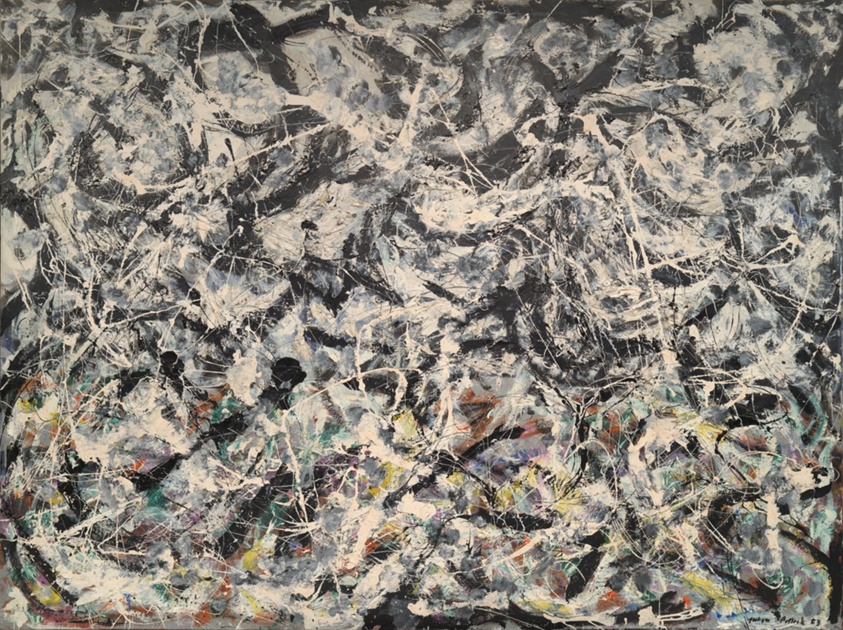 Jackson Pollock, "Greyed Rainbow" -- the drip technique that dissolved drawing into pure gestural energy. (Art Institute of Chicago, Museum Open Access)
Jackson Pollock represents the chaotic pole: his drip paintings eliminated the brush entirely, pouring and flinging paint across canvases laid on the floor, creating dense webs of line where no single mark holds priority over another. Mark Rothko represents the opposite extreme: luminous rectangular fields of color that hover on the canvas surface, pulsing with quiet emotional intensity that viewers often describe as spiritual or overwhelming. Between these poles -- gestural chaos and chromatic meditation -- Abstract Expressionism encompasses monumental scale, emotional intensity, and gestural brushwork as its defining characteristics.
"The most expressive of all the arts, music, gets along without representing anything. Would it not be possible to do the same in painting? To express a mood or emotion only by means of colours and lines?" -- The Story of Art, p. 438
The movement's frequency profile ranges from low frequency (Rothko's soft-edged color transitions) to chaotic (Pollock's all-over drip patterns), making it the widest-ranging style in our library -- and uniquely suited to landscapes, which share that same spectrum of atmospheric calm to textural complexity.
Why Abstract Expressionism Works for Landscapes Photos
The compatibility between Abstract Expressionism and landscape photography is rooted in a shared relationship to space and atmosphere. Rothko's color fields are, in essence, landscapes stripped to their emotional core -- horizontal bands of luminous color that evoke horizons, skies, and the boundary between earth and air without depicting any of them. When a neural network trained on Rothko's paintings encounters a landscape photograph, it recognizes structural analogues: the horizon line maps to the boundary between color fields, the sky maps to the upper chromatic zone, the foreground maps to the lower mass.
Pollock's contribution operates at the opposite scale. His allover drip technique creates chaotic, non-hierarchical textures that, applied to a landscape photograph, transform natural surfaces -- grass, leaves, water ripples, cloud formations -- into energized webs of gestural mark-making. The photograph's natural textures provide the substrate that Pollock's technique amplifies into visual complexity.
Abstract Expressionism's low frequency (Rothko) to chaotic (Pollock) frequency profile naturally complements landscape photographs, which contain low-to-mid frequency content: broad sky gradients, smooth horizon lines, atmospheric perspective that softens distant elements. The style does not fight against these frequencies -- it extends them, either smoothing gradients into Rothko-like chromatic meditation or exploding textures into Pollock-like gestural energy.
The LPIPS of 0.611 indicates significant transformation -- this is not a subtle filter but a fundamental reimagining of your photograph. The FID of 206.13 confirms strong style fidelity to Abstract Expressionist visual language. At 4 stars, landscapes represent one of the movement's strongest pairings, behind only animals (212.17, 5 stars) and fantasy (296.46, 5 stars) in raw score, but carrying deeper art-historical resonance.
ArtFID Quality Score: Landscapes + Abstract Expressionism
ArtFID (Artistic Frechet Inception Distance) combines two metrics: LPIPS measures content preservation, FID measures style fidelity. ArtFID = (1 + LPIPS) x (1 + FID). Lower = better.
| Content Type | ArtFID | Stars | Verdict |
|---|---|---|---|
| Animals | 212.17 | 5 | Excellent -- organic forms become gestural energy |
| Fantasy | 296.46 | 5 | Excellent -- imaginative content embraces abstraction |
| Street Scenes | 327.74 | 4 | Strong -- urban complexity channels Pollock's allover energy |
| Landscapes | 333.69 | 4 | Strong -- horizon and sky map to Rothko's color fields |
| Architecture | 340.27 | 4 | Good -- geometric structure anchors gestural chaos |
| Flowers | 342.01 | 4 | Good -- organic curves absorb chromatic transformation |
| Night Scenes | 342.43 | 4 | Good -- darkness intensifies Rothko-like luminosity |
| Food | 367.48 | 3 | Fair -- defined objects resist complete abstraction |
| Seascapes | 373.16 | 3 | Fair -- water surfaces compete with drip textures |
| Urban Scenes | 374.97 | 3 | Fair -- dense detail overwhelms gestural clarity |
| Interiors | 378.95 | 3 | Fair -- confined spaces limit monumental scale effect |
| Portraits | 401.34 | 2 | Challenging -- facial identity conflicts with abstraction |
| Travel | 429.24 | 2 | Challenging -- cultural specificity resists universalism |
| Vehicles | 433.34 | 2 | Challenging -- mechanical precision opposes gestural freedom |
| Still Life | 454.15 | 2 | Challenging -- defined objects resist dissolution |
Landscapes score: 333.69 (LPIPS = 0.611, FID = 206.13) -- Landscapes rank 4th out of 15 content types with a solid 4-star rating. The higher absolute ArtFID compared to more conservative styles like Impressionism reflects Abstract Expressionism's radical transformation ambition: this style does not gently modify your photograph but fundamentally reimagines it. The LPIPS of 0.611 means your landscape's compositional bones -- horizon placement, major landmasses, sky-to-ground ratio -- survive, but surface detail is aggressively reinterpreted through gestural energy or chromatic luminosity. Landscapes outperform architecture (340.27), night scenes (342.43), and all content types scoring 3 stars or below.
Before & After: Landscapes in Abstract Expressionism Style
Every row below shows three images: the original photograph, an Abstract Expressionism painting used as the style reference, and the AI-generated result.
Landscapes -- 4 Stars (ArtFID 333.69)
The landscape's spatial structure -- horizon line, sky mass, foreground texture -- provides the armature that Abstract Expressionism transforms. Depending on the reference painting, your landscape may acquire Rothko's luminous chromatic meditation or Pollock's energized gestural chaos. Either way, the photograph stops being a depiction of a place and becomes a visual experience.
| Original Photo | Style Reference | AI Result |
|---|---|---|
|
|
|
| Source photo | Pollock, "Greyed Rainbow" (AIC, Museum Open Access) | ArtFID: 333.69 -- 4 Stars |
LPIPS: 0.611 (content preservation) | FID: 206.13 (style fidelity)
Notice how the horizon remains as a compositional anchor while surface textures dissolve into gestural energy. Trees, grass, and sky lose their photographic specificity and gain the physical presence of paint applied with conviction. This is not a filtered photograph -- it is a landscape that has been rethought through the lens of Abstract Expressionism's commitment to direct emotional expression through material and gesture.
Photography Tips for Best Abstract Expressionism Results
Abstract Expressionism already scores 4 stars on landscapes, but the right source photograph maximizes the dramatic potential. These tips exploit the specific frequency interactions between Abstract Expressionist technique and landscape content.
-
Shoot landscapes with strong horizontal structure. Rothko's paintings are fundamentally about horizontal division -- luminous bands separated by soft boundaries. A landscape photograph with a clear, uncluttered horizon line gives the algorithm the structural parallel it needs to map Rothko's chromatic fields onto your scene. Wide-angle vistas with distinct sky/land separation produce the strongest results.
-
Seek atmospheric conditions. Fog, mist, haze, storm light -- conditions that already blur the boundary between solid and atmosphere align with Abstract Expressionism's dissolution of representation. A crystal-clear day with hard edges produces results that fight against the style's commitment to ambiguity. Atmospheric photographs meet the algorithm halfway, providing content that is already partially abstracted.
-
Include textural variety across the frame. Pollock's allover technique distributes visual energy uniformly across the canvas -- no single area dominates. A landscape with varied textures across the entire composition (foreground wildflowers, midground water, background forest, dramatic sky) gives the algorithm rich material at every scale, producing results with the non-hierarchical energy that defined Action Painting.
-
Favor vast, open spaces over tight compositions. Abstract Expressionism's defining innovation was monumental scale -- paintings so large they surrounded the viewer's peripheral vision. Expansive landscapes with a sense of limitless space resonate with this scale ambition. Tight telephoto crops of single trees or small details lack the spatial grandeur that defines the movement.
-
Experiment with both Pollock and Rothko references. The same landscape photograph will produce dramatically different results depending on whether you use a Pollock drip painting or a Rothko color field as the style reference. Pollock energizes textures into chaotic gesture; Rothko smooths gradients into luminous chromatic bands. Try both to discover which transformation serves your landscape best.
How to Apply Abstract Expressionism Style (3 Steps)
Step 1: Choose Your Photo
Upload any landscape photograph to ArtRobot. Based on our ArtFID testing, landscapes rank among Abstract Expressionism's strongest content pairings at 4 stars. Favor wide-angle shots with clear horizontal structure and atmospheric conditions.
Step 2: Select Abstract Expressionism Style
Choose from masterworks by Jackson Pollock or Mark Rothko as your style reference. ArtRobot uses the ArtFlow algorithm (CVPR 2021), an invertible neural network that preserves your landscape's compositional structure while transferring Abstract Expressionism's gestural energy, chromatic luminosity, and emotional intensity.
Step 3: Download Your Art
ArtRobot generates your Abstract Expressionism-style landscape in seconds. Download in multiple resolutions -- from social media sizes to print-ready 4K. The result works as contemporary wall art, a gallery-quality print, or a social media image that commands attention through its bold visual transformation.
Try Abstract Expressionism Style Transfer Free on ArtRobot ->
FAQ
How does Abstract Expressionism style transfer work on landscapes photos?
The algorithm extracts statistical texture patterns (Gram matrices) from Abstract Expressionist reference paintings -- works by Jackson Pollock and Mark Rothko -- and applies them to your landscape photograph. It preserves your photo's compositional structure (horizon line, major landmasses, sky-to-ground ratio) while transforming surface textures and color relationships toward Abstract Expressionism's characteristic gestural or chromatic vocabulary. The LPIPS of 0.611 indicates a bold transformation that maintains spatial coherence while reimagining every surface.
What ArtFID score does Abstract Expressionism get on landscapes?
Abstract Expressionism achieves 333.69 ArtFID on landscapes with a 4-star rating, ranking 4th out of 15 content types tested. The LPIPS of 0.611 reflects the movement's radical transformation ambition -- this is not a subtle filter but a fundamental reimagining. The FID of 206.13 confirms strong alignment with authentic Abstract Expressionist visual language: the output genuinely evokes Pollock's gestural energy or Rothko's chromatic luminosity rather than generic blur effects.
Is Abstract Expressionism a good choice for landscapes photography?
Abstract Expressionism is an excellent choice for landscapes that demand bold visual impact rather than subtle enhancement. At 4 stars, landscapes rank among the style's strongest content pairings. The connection is structurally deep: Rothko's color fields echo the horizontal division of sky and land, while Pollock's allover technique amplifies the textural richness of natural surfaces. If you want a landscape that looks like museum-quality contemporary art rather than a filtered photograph, Abstract Expressionism delivers that transformation. For comparison across all styles, see Best Art Styles for Landscapes.
What landscapes photo tips improve Abstract Expressionism results?
Four factors improve results most: (1) strong horizontal structure with a clear, uncluttered horizon line that maps to Rothko's chromatic bands; (2) atmospheric conditions (fog, mist, storm light) that align with the style's dissolution of representation; (3) textural variety distributed across the entire frame for Pollock-style allover energy; (4) vast, open spaces that resonate with Abstract Expressionism's monumental scale ambition. Experiment with both Pollock and Rothko references for dramatically different results from the same photograph.
Can I try Abstract Expressionism landscapes style transfer for free?
Yes. Visit ArtRobot to upload a landscape photograph and apply Abstract Expressionism style transfer at no cost. Choose from multiple reference paintings including Jackson Pollock's "Greyed Rainbow" and other masterworks from the Art Institute of Chicago's collection. The algorithm is the same ArtFlow neural network (CVPR 2021) used in our ArtFID benchmark testing.
Related Landscapes Styles
Explore more art styles for landscape photography:
- Landscapes Style Transfer Guide -- comprehensive comparison of all art styles tested on landscape photography
- Abstract Expressionism Style Transfer -- Abstract Expressionism performance across all 15 content types
- Best Art Styles for Landscapes -- top-performing styles ranked by ArtFID score
- Jackson Pollock Style Transfer -- the Action Painter whose drip technique dissolved drawing into pure gestural energy
- Mark Rothko Style Transfer -- the Color Field painter whose luminous rectangles evoke landscape without depicting it
Try It Yourself
Abstract Expressionism asked the most radical question in modern art: can a painting express everything a landscape makes you feel without depicting a single tree, hill, or cloud? Pollock answered with chaotic gesture; Rothko answered with luminous color. At 333.69 and 4 stars, the landscapes-Abstract Expressionism pairing creates something neither painter imagined -- your actual landscape photograph, reimagined through the visual language they invented. Upload your landscape to ArtRobot's Abstract Expressionism style transfer and see what happens when a postwar revolution in painting meets your photograph. Free credits included.
Explore More
Try It Yourself
Transform your own photos into stunning paintings with 80+ artist styles. Free to start.