
AI Artist & Tech Enthusiast
Landscape Anime — AI Style Transfer Guide [Free Tool 2026]
![Landscape Anime — AI Style Transfer Guide [Free Tool 2026] - ArtRobot AI Art](https://storage.googleapis.com/artrobot-storage/blog/pseo/stylized_images/ukiyo-e/landscapes_02_stylized.jpg)
Think of the most memorable anime backgrounds you have ever seen -- the rolling green hills in My Neighbor Totoro, the rain-soaked Tokyo streets in Your Name, the misty mountains in Princess Mononoke. These landscape anime scenes are not just backgrounds; they are characters in their own right. And they share a common visual ancestor: the Japanese woodblock print tradition of Ukiyo-e, where Katsushika Hokusai turned Mount Fuji into an icon viewed from thirty-six angles.
Now you can apply that same aesthetic to your own landscape photographs. ArtRobot's AI style transfer uses neural networks trained on museum-quality Ukiyo-e and Hokusai references to convert any scenery photo into an anime-style landscape. We tested both styles across 15 photo categories using the ArtFID quality benchmark -- and landscapes are among the best-performing subjects in the entire dataset. This guide gives you the numbers, the examples, and a step-by-step walkthrough.
Landscape photograph transformed into Ukiyo-e anime style -- Powered by ArtRobot AI
Quick Links -- Jump to: What is Landscape Anime? | Top Styles Ranked | Before & After Gallery | How to Create | FAQ | Related Guides
What is Landscape Anime? Where Japanese Art History Meets Digital Scenery
Landscape anime refers to the practice of rendering real-world scenery in the visual language of Japanese animation -- flat color planes, bold atmospheric layering, stylized natural forms, and a sense of depth achieved through tonal separation rather than photographic perspective. It is one of the most visually distinctive categories in all of anime art, and it has a direct lineage stretching back centuries.
The tradition begins with Ukiyo-e landscape masters. Hokusai's Thirty-six Views of Mount Fuji and Hiroshige's Fifty-three Stations of the Tokaido established a visual grammar for depicting landscapes that prioritized graphic impact over photographic accuracy: layers of flat color, atmospheric perspective through tone rather than blur, and a compositional boldness that turns nature into design.
"With the passing of the centuries the accumulation of tradition in Chinese painting played an ever-increasing role in the styles of individual artists. Nothing from the past was ever lost." -- The Pelican History of Art, p. 167
This tradition was never lost. When Hayao Miyazaki and his team at Studio Ghibli paint those breathtaking background panoramas, they are working in the same tradition that Hokusai perfected -- flat layers of atmospheric color, strong compositional framing, nature rendered with reverence and graphic clarity. Modern anime backgrounds are Ukiyo-e landscapes with a digital palette.
Why Landscapes are Ideal for Anime Style Transfer
From a technical perspective, landscape photographs are excellent candidates for neural style transfer because they share key structural properties with anime-style art:
- Large color regions -- Skies, fields, water bodies provide broad areas where flat-color application looks natural rather than forced.
- Clear spatial layering -- Foreground, midground, background. This is exactly how Ukiyo-e prints organize depth, and it is the structure that neural networks handle most cleanly.
- Atmospheric gradients -- Mist, haze, golden-hour light. These natural phenomena translate beautifully into the tonal separation that defines anime backgrounds.
- Minimal texture complexity -- Unlike portraits (facial details) or animals (fur), landscapes contain fewer high-frequency textures that resist the flat-color treatment.
Our ArtFID data confirms this: landscapes score 207.12 (Ukiyo-e) and 213.55 (Hokusai) -- solidly in the upper-middle range, well above challenging subjects like animals (311--351) and competitive with more structured subjects like architecture (129--196).
Top Styles for Landscape Anime (ArtFID Ranked)
ArtFID measures style transfer quality by balancing content preservation (LPIPS) and style authenticity (FID). ArtFID = (1 + LPIPS) x (1 + FID). Lower = better.
| Rank | Style / Artist | Mean ArtFID | Landscape ArtFID | Best Content Type | Best Score |
|---|---|---|---|---|---|
| 1 | Katsushika Hokusai | 209.11 | 213.55 | Fantasy | 81.57 |
| 2 | Ukiyo-e (generic) | 228.52 | 207.12 | Fantasy | 69.27 |
Key findings for landscape anime:
An interesting reversal happens with landscapes specifically: Ukiyo-e edges out Hokusai (207.12 vs. 213.55) even though Hokusai has a better overall mean. This makes sense -- generic Ukiyo-e references encompass the full landscape tradition (including Hiroshige's softer atmospheric work), while Hokusai's individual style leans toward dramatic, high-energy compositions that sometimes overpower gentle scenery.
For landscape anime creation, the recommendation depends on your source material: - Ukiyo-e for gentle, atmospheric landscapes -- rolling hills, misty mountains, calm water - Hokusai for dramatic landscapes -- crashing waves, stormy skies, mountain peaks, dynamic compositions
Landscape vs. Other Content Types
| Content Type | Ukiyo-e ArtFID | Hokusai ArtFID | Notes |
|---|---|---|---|
| Fantasy | 69.27 | 81.57 | Best overall -- fantasy landscapes are the sweet spot |
| Flowers | 109.11 | 99.91 | Botanical close-ups |
| Architecture | 196.29 | 129.92 | Strong structural lines |
| Landscapes | 207.12 | 213.55 | Excellent for anime backgrounds |
| Seascapes | 253.85 | 258.98 | Coastal scenery |
| Travel | 224.39 | 155.48 | Travel photography |
| Night Scenes | 222.30 | 218.69 | Nocturnal landscapes |
Fantasy content scores best because it combines landscape composition with stylized, non-realistic elements -- essentially, it is already halfway to anime. Pure landscape photographs score well because their spatial structure aligns with Ukiyo-e's layered composition philosophy.
Before & After: Landscape Anime Examples
Every result generated automatically by ArtRobot's AI -- no manual editing. All style references are CC0 / Public Domain artworks.
Ukiyo-e Landscape (Atmospheric Style)
 |
|
| Original Landscape Photo | Ukiyo-e Landscape Anime Result (ArtFID: 207.12) |
The Ukiyo-e treatment transforms natural gradients into graphic color layers -- exactly the look of a Studio Ghibli background painting. Notice how the sky becomes a defined color plane while the foreground retains its compositional weight.
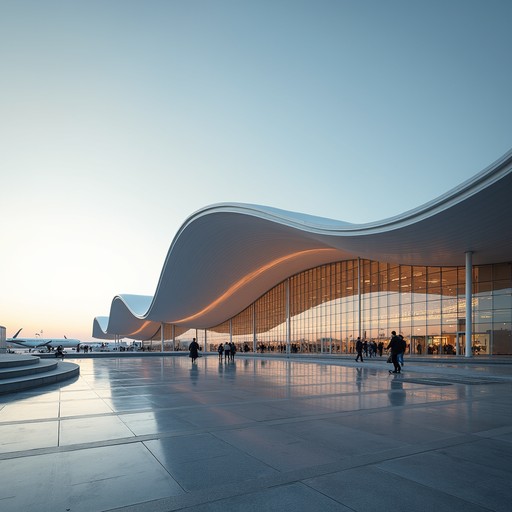
Ukiyo-e Architecture in Landscape Context
 |
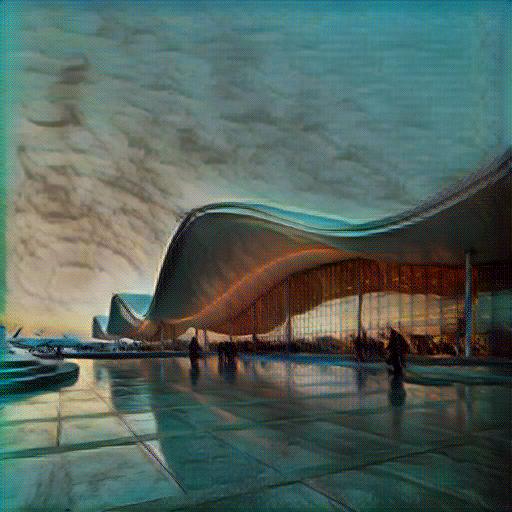 |
| Original Architecture Photo | Ukiyo-e Landscape Architecture Result (ArtFID: 196.29) |
When architecture meets landscape, the anime style transfer produces results reminiscent of urban anime backgrounds -- think Your Name or Weathering with You. The geometric lines of buildings combine with atmospheric landscape elements for a compelling composite.
Hokusai Landscape (Dynamic Style)
 |
 |
| Original Landscape Photo | Hokusai Landscape Anime Result (ArtFID: 213.55) |
Hokusai's bold compositional approach adds dynamic energy to landscape photographs. Where Ukiyo-e produces serene backgrounds, Hokusai produces landscapes that feel alive with movement -- closer to the dramatic establishing shots in action anime.
Hokusai Flowers in Landscape
 |
 |
| Original Flowers Photo | Hokusai Botanical Landscape (ArtFID: 99.91) |
Hokusai's botanical studies are legendary. Close-up landscape elements like flowers score among the best in our entire dataset, producing results that blend anime aesthetics with genuine artistic pedigree.
How to Create Landscape Anime with ArtRobot (3 Steps)
Step 1: Upload Your Landscape Photo
Go to ArtRobot and upload any landscape photograph. Golden hour lighting, clear foreground interest, and visible atmospheric layers produce the best results. Supported formats: JPG, PNG, WebP. No account required.
Pro tip: Panoramic compositions with distinct foreground/background separation convert most effectively. Avoid cluttered scenes with too many overlapping elements.
Step 2: Choose Your Landscape Anime Style
For gentle, atmospheric landscapes (Ghibli-style), choose Ukiyo-e (ArtFID: 207.12 on landscapes). For dramatic, high-energy scenery, choose Hokusai (ArtFID: 213.55). Both produce excellent landscape anime results -- the difference is mood. Each style shows a quality rating and preview thumbnail.
Step 3: Download Your Anime Landscape
Your landscape anime transfer completes in seconds. Download at standard resolution (1024px) for free -- perfect for social media headers and phone wallpapers. Upgrade to HD (2048px) or 4K (4096px) for desktop wallpapers, prints, and professional-quality anime backgrounds.
3 free transfers, no signup required. Premium plans unlock HD/4K, batch processing, and the full 121+ style library.
Try Landscape Anime Style Transfer Free on ArtRobot
FAQ
How do I create landscape anime with ArtRobot?
Upload your landscape photo to ArtRobot, select an anime-family style (Ukiyo-e for atmospheric results, Hokusai for dynamic energy), and download your result. The process takes seconds. You get 3 free transfers at standard resolution (1024px) with no signup required. The AI uses neural style transfer with museum-quality Japanese art references to transform your scenery into anime-style backgrounds.
What art style works best for landscape anime?
Based on our ArtFID testing, Ukiyo-e (ArtFID: 207.12 on landscapes) slightly outperforms Hokusai (213.55) for landscape-specific content. Ukiyo-e produces the serene, atmospheric look associated with Studio Ghibli backgrounds. Hokusai produces more dynamic, high-energy landscapes. For fantasy-landscape hybrids, Ukiyo-e achieves the best score in our entire dataset: 69.27.
Is it free to create landscape anime online?
Yes. ArtRobot offers 3 free transfers at standard resolution (1024px) with no signup, no watermark, and no account required. This is sufficient for social media and phone wallpapers. Premium plans unlock HD (2048px) and 4K (4096px) resolution for desktop wallpapers, prints, and professional output.
What photo resolution works best for landscape anime?
1024px standard is free and works for social media. HD (2048px) is recommended for desktop wallpapers and online portfolios. 4K (4096px) is ideal for large-format prints and professional anime background work. For landscapes specifically, higher resolution preserves the atmospheric layering and spatial depth that define the anime landscape aesthetic.
Can I use my landscape anime results commercially?
Personal use is free with the standard plan. Commercial use is available with premium plans. All style references are CC0 / Public Domain museum artworks from the Art Institute of Chicago, so there are no copyright concerns on the style side. Your output is uniquely generated from your input photograph.
Explore Related Guides
Landscape anime is one facet of the broader anime art ecosystem. Explore these related collections:
- Anime Art Style -- The complete hub covering all anime-family styles, history, and techniques.
- Hokusai Style Transfer -- Deep dive into the master of The Great Wave and his landscape techniques.
- Ukiyo-e Style Transfer -- The woodblock print tradition that defined Japanese landscape art for centuries.
- Turn a Photo into Anime Style -- Step-by-step guide for converting any photo (not just landscapes) to anime.
- Anime AI -- The broader intersection of AI technology and anime-style creation.
- Manga Art Style -- The black-and-white counterpart to anime, with landscape panels that share Ukiyo-e DNA.
- Free Anime Generator -- Budget-friendly options for creating anime art from photos.
- Cartoon Art Style -- Western illustration style with a different approach to landscape rendering.
Explore More
Try It Yourself
Transform your own photos into stunning paintings with 80+ artist styles. Free to start.