
AI Artist & Tech Enthusiast
Portraits Pointillism Photo Effect — AI Art [ArtFID Tested]
![Portraits Pointillism Photo Effect — AI Art [ArtFID Tested]](https://storage.googleapis.com/artrobot-storage/blog/pseo/stylized_images/pointillism/portraits_01_stylized.jpg)
The portraits Pointillism photo effect dissolves a photograph into thousands of individual color dots — tiny chromatic particles that reassemble into a recognizable face only when you step back and let your eye do the mixing. We tested this pairing with ArtFID and the results tell an honest story: 311.86 ArtFID with a 4-star rating, placing portraits ninth out of 15 content types for Pointillism. That is solidly mid-range. Pointillism is a style that excels on broad color fields and open compositions — eight of its 15 content types earn a perfect 5 stars — but human faces, with their demand for fine anatomical detail, present a genuine challenge for a technique built entirely from dots.
That said, there is something magnetic about a pointillist portrait. The dots create a luminous, shimmering quality in skin tones that no other style achieves — a face that seems to glow from within, vibrating between warm and cool at the pixel level. It is not the style's strongest pairing, but it may be its most visually surprising one.
Portraits — Van Gogh Style Transfer

About Pointillism Art Style
Pointillism was born in 1886 when Georges Seurat exhibited "A Sunday on La Grande Jatte" at the eighth and final Impressionist exhibition in Paris. Where the Impressionists had applied color in loose, intuitive brushstrokes, Seurat proposed something radically methodical: painting entirely with tiny, distinct dots of pure color placed according to scientific theories of optics and color perception. He called his method "Chromo-Luminarism," though the press quickly coined the term "Pointillism" — a label Seurat reportedly despised for reducing his systematic approach to a mere technique.
"Some say they see poetry in my paintings; I see only science." — Georges Seurat
The theory was rooted in the work of Michel Eugene Chevreul and Ogden Rood, color scientists who demonstrated that juxtaposing complementary hues produced more vibrant visual mixtures than blending pigments on a palette. Seurat seized on this principle. Instead of mixing green on his palette, he placed blue dots next to yellow dots and trusted the viewer's retina to perform the synthesis. The result, when it works, is an extraordinary luminosity — colors that seem lit from behind, pulsing with an internal radiance that premixed pigment cannot achieve.
 Georges Seurat, "A Sunday on La Grande Jatte — 1884" — the monumental canvas that launched Pointillism. Every square inch is built from meticulously placed dots of pure color. (Art Institute of Chicago, CC0)
Seurat's technique required extraordinary discipline. "La Grande Jatte" took two years to complete — two years of applying individual dots across a canvas over two meters wide. The method was adopted by Paul Signac, Henri-Edmond Cross, and briefly by Camille Pissarro, though few had the patience to sustain it with Seurat's rigor. The movement peaked in the 1890s and early 1900s, its influence rippling outward into Fauvism and eventually into the halftone printing process that would dominate twentieth-century image reproduction.
What makes Pointillism distinctive as a style transfer source is its very high frequency dot pattern and its reliance on optical mixing — the idea that color is constructed in the viewer's eye rather than on the canvas. This creates a visual texture that is uniform, systematic, and luminous. It rewards subjects with large, unbroken color areas where the dot technique can fully express itself, while subjects requiring fine linear detail — architectural moldings, facial features — present an inherent tension between the dot grid and the structural precision the subject demands.
Why Pointillism Works for Portraits Photos
The numbers demand honesty. Portraits rank ninth out of 15 content types for Pointillism with an ArtFID of 311.86. That is lower mid-range — behind eight content types that all earn 5 stars. The gap is substantial: Still Life leads at 156.34, nearly half the portraits score. Travel (205.63), Interiors (211.81), and Street Scenes (235.87) all comfortably outperform portraits as well. If pure ArtFID performance is your goal, Pointillism has dramatically better pairings available.
The reason comes down to frequency. Pointillism operates at very high visual frequency — its entire vocabulary consists of systematic dots. This technique is superb at rendering broad, flat color areas where each dot contributes to a shimmering, luminous field. A still life arrangement of fruit, a sunlit park, a city street bathed in afternoon light — these subjects provide expansive color zones where the dot pattern can breathe. Still Life's remarkable 156.34 score reflects this perfectly: objects with smooth, distinct color regions translate into pointillist compositions almost effortlessly.
Faces are a different problem. Human portraiture depends on mid-frequency detail — the subtle gradation from cheekbone shadow to highlight, the precise curve of a lip, the delicate structure around the eyes. These features require controlled tonal transitions, not individual dots. When Pointillism's dot grid meets a human face, it can fragment the very details that make a portrait read as a specific person rather than a generic figure. The optical mixing that creates gorgeous luminosity in a landscape can soften facial definition to the point where expression becomes ambiguous.
But here is where the interesting tension lies. That same dot-driven luminosity creates skin tones unlike anything other styles produce. Each area of flesh is rendered as a mosaic of warm pinks, cool blues, pale yellows, and subtle greens that fuse optically into something warmer and more alive than any flat skin tone. The face shimmers. It glows. Seurat himself painted portraits — "Young Woman Powdering Herself" shows exactly this quality — and the effect is hypnotic even when some anatomical precision is sacrificed.
The 4-star rating reflects this compromise accurately. Pointillism portraits are not the style's strongest technical achievement, but they are among its most visually distinctive results.
ArtFID Quality Score: Portraits + Pointillism
ArtFID (Art-aware Frechet Inception Distance) is the standard benchmark for neural style transfer quality. It evaluates how faithfully the artistic style was applied while preserving the original content structure. Lower scores indicate better results, and we convert raw scores into a 5-star rating for clarity.
Portraits + Pointillism: 311.86 ArtFID (4 Stars) — RANK #9 of 15
| Metric | Value |
|---|---|
| ArtFID Score | 311.86 |
| LPIPS (Perceptual Similarity) | 0.4016 |
| FID (Style Fidelity) | 221.5 |
| Star Rating | 4 / 5 |
| Content Rank | 9th out of 15 |
The LPIPS of 0.4016 is notably high — indicating a strong perceptual transformation. Pointillism does not make subtle adjustments to your photograph; it fundamentally reconstructs the image from individual dots, producing a result that looks dramatically different from the source. The FID of 221.5 confirms solid style fidelity — the output genuinely reads as a Pointillist composition, capturing the dot technique and optical mixing that define the movement.
Here is how Pointillism performs across all 15 content types:
| Content Type | ArtFID | Stars |
|---|---|---|
| Still Life | 156.34 | 5 |
| Travel | 205.63 | 5 |
| Interiors | 211.81 | 5 |
| Street Scenes | 235.87 | 5 |
| Fantasy | 239.6 | 5 |
| Urban Scenes | 265.89 | 5 |
| Vehicles | 268.43 | 5 |
| Night Scenes | 277.1 | 5 |
| Portraits | 311.86 | 4 |
| Landscapes | 316.12 | 4 |
| Food | 319.13 | 4 |
| Architecture | 319.51 | 4 |
| Flowers | 331.26 | 4 |
| Seascapes | 375.28 | 3 |
| Animals | 381.95 | 3 |
The table reveals Pointillism's remarkable consistency — eight content types at 5 stars is one of the strongest top-tier showings of any style we have tested. The style dominates subjects with broad color areas and open spatial compositions: Still Life (156.34) and Travel (205.63) lead by wide margins. Portraits sits at the boundary between the 5-star elite and the 4-star middle tier, essentially tied with Landscapes (316.12) and Food (319.13). The real weakness shows at the bottom with Seascapes and Animals, where dynamic organic forms resist the dot grid's systematic structure. Worth noting: Architecture (319.51) ranks below Portraits here, which is unusual — most historical styles favor architecture. Pointillism's dots handle the geometry of buildings no better than they handle faces, which reinforces that this is a style governed by color-field logic rather than structural logic.
Before & After: Portraits in Pointillism Style
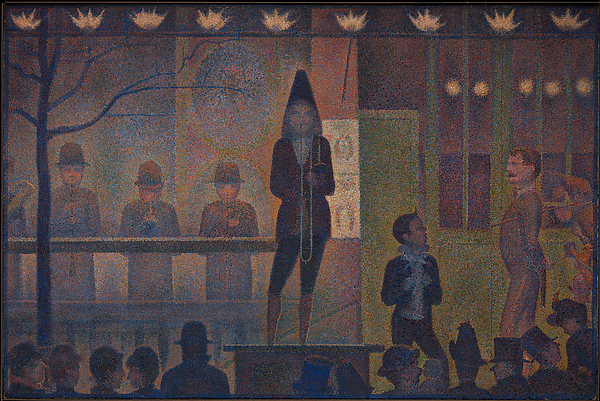
See the transformation for yourself. The three-column comparison shows the original photograph, the style reference painting used to guide the neural network, and the final AI-generated result:
| Original Portrait | Style Reference | AI Result |
|---|---|---|
|
 |
|
| Source photograph | Georges Seurat, "Circus Sideshow (Parade de cirque)" (Met, CC0) | Pointillism AI style transfer |
Technical breakdown:
| Metric | Value | What It Means |
|---|---|---|
| LPIPS | 0.4016 | Strong perceptual transformation — the portrait is fundamentally reconstructed from individual dots |
| FID | 221.5 | Good style fidelity — the output carries authentic Pointillist visual DNA |
| ArtFID | 311.86 | Mid-range score — optical mixing effect achieved, though facial detail competes with dot frequency |
Look closely at how the transformation treats skin. Where the original photograph has smooth, continuous tonal gradients across the face, the Pointillist result replaces those gradients with a mosaic of individual color dots — warm pinks adjacent to cool blues, pale yellows nestled against muted greens. At full zoom, the face dissolves into abstract color particles. Step back, and the optical mixing takes over: the dots fuse into luminous flesh tones that glow with an inner warmth no flat color can replicate. The effect is less precise than Classicism or Realism, but more radiant — a portrait that trades anatomical sharpness for chromatic vitality. The background and clothing areas, with their broader color fields, often look even more striking than the face itself, which is consistent with the style's overall preference for open color zones.
Photography Tips for Best Pointillism Results
Based on our ArtFID testing, here are practical recommendations for maximizing your Pointillism portrait results:
-
Use bright, even lighting with strong color saturation. Pointillism depends on distinct color dots to create its optical mixing effect. Flat, desaturated lighting produces flat, muddy dots. Bright natural light with clear color temperature gives the algorithm richer chromatic material to decompose into individual dot colors.
-
Choose simple, uncluttered backgrounds. Busy backgrounds fragment into chaotic dot patterns that compete with the face for visual attention. A solid-color wall, open sky, or soft bokeh provides clean color fields where the dot technique looks most impressive — and keeps the portrait as the focal point.
-
Favor strong color contrast in clothing and accessories. Pointillism thrives on color juxtaposition. A subject wearing a vivid blue shirt against warm skin tones gives the algorithm dramatic complementary color pairs to work with. Monochromatic outfits produce less visually dynamic results.
-
Prefer slightly larger facial features in the frame. Fine detail is Pointillism's weakness. A tightly cropped headshot with delicate eyelashes and subtle lip textures will lose more detail to the dot grid than a medium shot where facial features are rendered at a larger, more robust scale. Frame generously.
-
Avoid fine accessories like thin jewelry or detailed eyeglasses. The dot technique cannot resolve very thin lines — fine chains, wire-frame glasses, and intricate earrings will dissolve into the surrounding dot pattern. Remove or simplify accessories for cleaner results.
How to Apply Pointillism Style (3 Steps)
Applying Pointillism style to your portrait takes under a minute with ArtRobot's AI style transfer tool.
Step 1: Upload Your Portrait
Go to ArtRobot.ai and upload the portrait photograph you want to transform. JPEG, PNG, and WebP formats are all supported. For the best Pointillism results, use a brightly lit portrait with saturated colors and a clean background.
Step 2: Select Pointillism Style
Choose Pointillism from the art style library. The style is trained on masterworks by Georges Seurat and the Neo-Impressionist school. You can also explore the full portraits style transfer guide to compare Pointillism side-by-side with other styles.
Step 3: Generate and Download
Click generate and wait a few seconds for the neural network to process your image. Download the full-resolution result and use it however you like — print it, share it, or frame it. New users receive free credits, so there is no financial commitment required to see what Seurat's scientific approach to color looks like applied to your own face.
FAQ
How does Pointillism style transfer work on portraits photos?
Pointillism style transfer uses a neural network trained on masterworks from the Neo-Impressionist movement — primarily by Georges Seurat — to re-render your portrait photograph as a composition of tiny, distinct color dots. The algorithm decomposes the continuous tones of your photograph into individual chromatic particles that optically mix at viewing distance, recreating the luminous effect that Seurat achieved through painstaking manual dot placement. Your subject's identity and basic structure are preserved while the rendering method shifts entirely to the dot-based Pointillist technique.
What ArtFID score does Pointillism get on portraits?
Pointillism achieves an ArtFID score of 311.86 on portraits, earning a 4-star rating. This places portraits ninth out of 15 content types tested — a mid-range result. The score reflects the fundamental tension between Pointillism's dot technique and the fine detail that facial features demand. For comparison, Still Life achieves 156.34 (5 stars) because its broad color areas suit the dot technique perfectly.
Is Pointillism a good choice for portraits photography?
It is a viable choice that produces visually distinctive results, though it is not the style's strongest content type. Eight of Pointillism's 15 content categories earn 5 stars, but portraits is not among them. The dot technique creates gorgeous luminous skin tones through optical color mixing, but sacrifices some facial precision in the process. If you want maximum Pointillism quality, try still life or travel subjects. If you want a portrait that shimmers with chromatic energy unlike anything other styles produce, Pointillism delivers that unique quality.
What portraits photo tips improve Pointillism results?
Use bright, even lighting with strong color saturation — Pointillism needs distinct color information to create effective dot patterns. Choose simple backgrounds and bold color contrast in clothing. Frame the face at a medium distance rather than an extreme close-up, since larger facial features survive the dot grid better than fine details. Avoid thin accessories like wire-frame glasses or delicate jewelry, which dissolve into the dot pattern.
Can I try Pointillism portraits style transfer for free?
Yes. ArtRobot provides free credits to every new user, so you can upload a portrait and apply Pointillism style transfer without any payment. Visit ArtRobot.ai to start immediately.
Related Portraits Styles
- Portraits Style Transfer Guide — comprehensive comparison of all art styles tested on portrait photography
- Pointillism Style Transfer — Pointillism performance across all content types
- Best Art Styles for Portraits — top-performing styles ranked by ArtFID score
- Georges Seurat Style Transfer — the inventor of Pointillism and master of chromatic dot composition
Try It Yourself
Portraits earn a 4-star ArtFID score of 311.86 with Pointillism — not the style's strongest pairing, but one that produces results unlike anything else in the art style library. The dot technique trades some facial precision for extraordinary chromatic luminosity, creating portraits that shimmer with the same optical energy Seurat spent two years building into "La Grande Jatte." Upload your portrait to ArtRobot's Pointillism style transfer and discover what scientific color theory looks like applied to a modern face. Free credits included.
Try It Yourself
Transform your own photos into stunning paintings with 80+ artist styles. Free to start.