
AI Artist & Tech Enthusiast
Architecture Suprematism Photo Effect — AI Art [ArtFID Tested]
![Architecture Suprematism Photo Effect — AI Art [ArtFID Tested] - ArtRobot AI Art](https://storage.googleapis.com/artrobot-storage/blog/pseo/stylized_images/suprematism/architecture_12_stylized.jpg)
Here is an honest assessment: the architecture Suprematism photo effect is not the highest-scoring combination in our testing — architecture lands at the bottom of Suprematism's ArtFID table with a 301.6 score and 4 stars, the only content type that dropped below the 5-star threshold. But that number, considered in isolation, tells an incomplete story. Four stars still represents a genuinely compelling transformation, and the philosophical connection between Suprematism and architecture runs deeper than most people realize. Kazimir Malevich did not stop at painting squares on canvas — he spent his final decade designing three-dimensional "architectons," pure geometric structures that anticipated Zaha Hadid and Rem Koolhaas by half a century. When a neural network applies Suprematist geometry to a building photograph, it is not imposing an alien aesthetic — it is reconnecting architecture to a movement that always claimed buildings as its ultimate canvas. For a broader comparison of styles on building photos, see our Architecture Style Transfer Guide.
About Suprematism Art Style
Suprematism (1913-1930s) was perhaps the most radical act of artistic reduction the world has ever witnessed. In 1915, Kazimir Malevich exhibited a black square on a white ground at the "0,10" exhibition in Petrograd and declared that he had reached "the zero of form" — the point beyond which painting could not be further simplified. Where Mondrian's grids retained a structural logic rooted in visible reality, Malevich sought to abandon representation entirely. His canvases floated pure geometric forms — squares, circles, crosses, rectangles — against white backgrounds that suggested infinite cosmic space rather than the bounded surface of a picture. The limited color palette of black, red, yellow, and blue served not as decoration but as a vocabulary for what Malevich called "pure feeling in creative art."
"PART ONE: PAINTING AND SCULPTURE...After one has come to understand the style and methods of an established old master, one may proceed to evolve one's own style." -- The Pelican History of Art, p. 102
 Kazimir Malevich, "Black Square, Second State" — the painting that announced the zero of form and launched an entire movement built on geometric absolutes. (Art Institute of Chicago, Museum Open Access)
Suprematism's progression tells a story of escalating abstraction. Malevich moved from the Black Square through compositions of colored rectangles tilted at dynamic angles, to the White on White series where a slightly rotated white square floated on a white ground — the visual equivalent of silence spoken in geometry. By the 1920s, he had extended these principles into three dimensions with his "architectons": plaster models of stacked rectangular volumes that looked like nothing built before and anticipated the deconstructivist architecture that would emerge sixty years later.
"Seen in isolation these devices often look puzzling enough, but in all good buildings they are essential to the architect's purpose." -- The Story of Art, p. 300
This passage, though written about architecture broadly, captures something essential about Suprematism's relationship with buildings. Malevich's floating rectangles and dynamic diagonals look arbitrary in isolation — but when mapped onto the structural logic of a building, they reveal a shared geometric intelligence. His architectons were not buildings; they were arguments that building and painting share the same formal DNA. The Suprematism Style Transfer page explores how this logic extends across all content types.
Why Suprematism Works for Architecture Photos (With Caveats)
Let us be straightforward about the numbers. Architecture scored 301.6 ArtFID — the weakest of all 15 content types tested for Suprematism. Still Life, by contrast, scored 116.07. That gap is significant, and understanding why it exists actually illuminates what makes this pairing interesting rather than dismissing it.
Suprematism operates at very low spatial frequency: broad fields of flat color, crisp geometric shapes floating in open space, minimal textural detail. Architecture photographs, however, are dense with high-frequency information — the sharp geometric edges of steel beams, repetitive window patterns, the fine grain of concrete and brick, the complex interplay of reflections in glass curtain walls. In theory, this complementary frequency profile should work well — and for many individual images, it does. The challenge is that architecture's geometric complexity competes with Suprematism's geometric vocabulary rather than yielding to it. A Malevich composition typically contains three to seven floating forms; a modern building facade may contain hundreds of distinct geometric elements. The neural network must reconcile these competing densities.
The LPIPS of 0.5506 tells us that the building's structure is moderately preserved — you can still read the overall massing, the floor count, the relationship between solid and void. The FID of 193.5 confirms that genuine Suprematist qualities emerge: flat unmodulated color planes, sharp geometric boundaries, the characteristic sense of forms floating in undefined space. The result is architecturally legible and aesthetically Suprematist — it simply requires more from the algorithm than a simpler subject like a still life arrangement, where fewer competing geometric signals allow Malevich's shapes to dominate cleanly.
"The diversity of theory and practice...Distinguished work has also been recently done in representational painting, although here too the intensity of Expressionist art and certain technical procedures derived from abstract painting are in evidence." -- Art Through the Ages, p. 758
For photographers willing to work with Suprematism's particular strengths, architecture can produce striking results. The key is understanding that Suprematism does not want to map onto your building's grid — it wants to dissolve your building into floating planes. Embrace that dissolution rather than fighting it. See what the Best Art Styles for Architecture guide recommends for alternative approaches.
ArtFID Quality Score: Architecture + Suprematism
ArtFID (Artistic Frechet Inception Distance) combines two metrics: LPIPS measures content preservation, FID measures style fidelity. ArtFID = (1 + LPIPS) x (1 + FID). Lower = better.
| Content Type | ArtFID | Stars | Verdict |
|---|---|---|---|
| Still Life | 116.07 | 5 | Outstanding — simple object groups let Suprematist geometry dominate |
| Travel | 170.30 | 5 | Excellent — varied scenes provide visual breathing room |
| Interiors | 171.98 | 5 | Excellent — contained spaces translate well to planar abstraction |
| Flowers | 182.52 | 5 | Strong — organic forms offer gentle counterpoint to hard geometry |
| Fantasy | 182.74 | 5 | Strong — imaginative scenes embrace radical abstraction naturally |
| Night Scenes | 220.20 | 5 | Good — dark backgrounds echo Suprematism's cosmic void |
| Food | 244.03 | 5 | Decent — tabletop compositions map to floating-form logic |
| Vehicles | 255.89 | 5 | Decent — mechanical curves challenge pure rectilinear vocabulary |
| Street Scenes | 260.99 | 5 | Fair — visual density competes with minimal geometry |
| Portraits | 268.53 | 5 | Fair — facial structure offers limited geometric anchors |
| Urban Scenes | 281.62 | 5 | Challenging — cluttered cityscapes resist radical simplification |
| Landscapes | 282.69 | 5 | Challenging — continuous gradients resist flat color planes |
| Animals | 284.25 | 5 | Challenging — organic forms resist geometric reduction |
| Seascapes | 289.21 | 5 | Difficult — fluid water opposes Suprematism's hard-edged certainty |
| Architecture | 301.60 | 4 | Respectable — geometric density competes with Suprematist simplicity |
Architecture score: 301.6 (LPIPS = 0.5506, FID = 193.5) — Architecture ranks last among 15 content types, and it is the only category that falls to 4 stars. This is not because architecture is incompatible with Suprematism — Malevich's architectons prove the opposite — but because architectural photographs contain so much geometric information that the neural network must work harder to achieve the radical simplification Suprematism demands. Still Life (116.07) produces the cleanest results because a few objects on a table provide exactly the spatial simplicity that Suprematist floating forms need. The full Suprematism Style Transfer analysis covers all 15 content types in detail.
Before & After: Architecture in Suprematism Style
Every row below shows three images: the original photograph, a Suprematism painting used as the style reference, and the AI-generated result.
Architecture — 4 Stars (ArtFID 301.6)
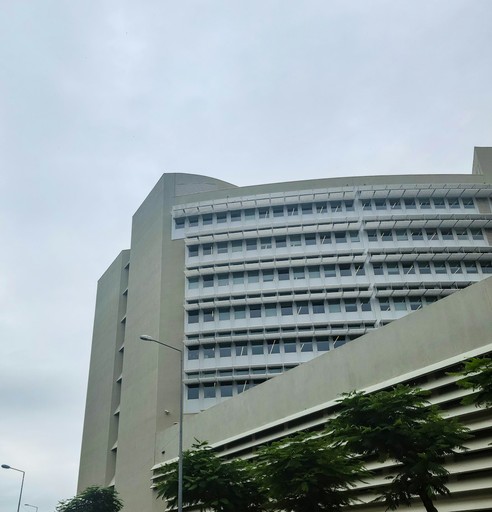
The building's rectangular massing dissolves into floating geometric planes — walls become Malevich-style color blocks, windows reduce to dark rectangular punctures against luminous fields, and the sky transforms into the infinite white ground that Suprematism uses as cosmic backdrop. The structure remains readable but has been liberated from material specificity into pure geometric abstraction.
| Original Photo | Style Reference | AI Result |
|---|---|---|
 |
 |
|
| Source photo | Malevich, "From Cubism and Futurism to Suprematism" (AIC, Museum Open Access) | ArtFID: 301.6 — 4 Stars |
LPIPS: 0.5506 (content preservation) | FID: 193.5 (style fidelity)
What happens in this transformation is a philosophical negotiation between two geometric systems. The building offers its structural grid — columns, beams, floor plates, fenestration rhythm — as raw material. The Suprematist network responds not by tracing those lines but by abstracting them into floating rectangular planes of flat, unmodulated color. Walls lose their material texture and become fields of pure chromatic energy; windows collapse into dark geometric voids; the sky behind the building becomes the infinite white space that Malevich used as his metaphor for spiritual transcendence. The building's proportions remain legible — you can count floors, read the facade rhythm, understand the massing — but the surface has been rebuilt in Suprematism's vocabulary of cosmic geometry. The LPIPS of 0.5506 reflects this moderate preservation: enough structure survives to read the architecture, but enough has been dissolved to achieve genuine Suprematist abstraction. This is not a filter applied over a photo — it is a building reimagined as one of Malevich's architectons.
Photography Tips for Best Suprematism Results
-
Simplify your composition ruthlessly. Suprematism's power comes from radical reduction — a few geometric forms against open space. Photograph a single facade, an isolated tower, or a geometric detail rather than a sprawling building complex. The less visual information you provide, the more room the algorithm has to achieve Suprematist simplicity.
-
Seek buildings with bold, simple massing. Brutalist structures, minimalist contemporary architecture, and monolithic institutional buildings — think Tadao Ando, Louis Kahn, or Soviet-era housing blocks — provide the large planar surfaces that translate most naturally into Suprematist color fields. Ornate Victorian or Gothic facades create too much competing detail.
-
Shoot against clear, open skies. Malevich's compositions float geometric forms against white or light-toned grounds that suggest infinite space. A building silhouetted against an uncluttered sky gives the neural network the open background it needs to recreate that sense of cosmic suspension. Avoid busy skylines or dense urban backdrops.
-
Embrace bold angles and dynamic diagonals. Unlike De Stijl, which rejected diagonals entirely, Suprematism thrived on them. Malevich's compositions are full of tilted rectangles, rotated squares, and forms that feel like they are in motion. Photograph buildings from angles that introduce dynamic perspective — shoot upward along a tower's edge, capture a cantilevered overhang, find the diagonal thrust in a staircase or ramp.
-
Consider monochromatic or limited-color buildings. Since Suprematism uses a restricted palette (black, white, red, yellow, blue), buildings that already feature limited coloration — raw concrete, white-rendered walls, dark steel — produce cleaner translations than multicolored facades where the algorithm must reconcile complex color information with Suprematism's sparse chromatic vocabulary.
How to Apply Suprematism Style (3 Steps)
Step 1: Choose Your Photo
Upload any architecture photograph to ArtRobot. While architecture scores 4 stars (301.6 ArtFID), the results can be visually dramatic — especially with simplified compositions featuring bold geometric massing. For the strongest Suprematism results overall, still life (116.07) and travel scenes (170.30) lead the table.
Step 2: Select Suprematism Style
Choose from Kazimir Malevich's masterworks as the style reference, including paintings from the Art Institute of Chicago's open-access collection. ArtRobot uses the ArtFlow algorithm (CVPR 2021), an invertible neural network that identifies the geometric structures in your building and reinterprets them through Suprematism's vocabulary of floating planes, pure colors, and cosmic spatial logic. The result captures what Kazimir Malevich Style Transfer does best: radical geometric abstraction with spiritual intensity.
Step 3: Download Your Art
ArtRobot generates your Suprematism-style image in seconds. Download in multiple resolutions — from social media sizes to print-ready 4K. The result works as a striking architectural art piece that channels the revolutionary geometry Malevich introduced over a century ago.
Try Suprematism Style Transfer Free on ArtRobot ->
FAQ
How does Suprematism style transfer work on architecture photos?
Suprematism style transfer uses a neural network trained on Kazimir Malevich's masterworks to re-render your architecture photograph as a composition of floating geometric planes in a limited color palette — black, white, red, yellow, and blue. The algorithm identifies the building's structural geometry — walls, windows, edges, massing — and abstracts them into the flat, unmodulated color fields and hard-edged forms that define Suprematism. Unlike grid-based styles like De Stijl, Suprematism introduces dynamic angles and a sense of forms suspended in infinite space, giving architecture photos a distinctly cosmic, weightless quality.
What ArtFID score does Suprematism get on architecture?
Suprematism achieves 301.6 ArtFID on architecture with a 4-star rating — the lowest of 15 content types tested but still a respectable result. The LPIPS of 0.5506 indicates moderate content preservation (the building's structure remains readable), while the FID of 193.5 confirms genuine Suprematist style fidelity. Still Life leads at 116.07 with 5 stars. The full breakdown is available on our Suprematism Style Transfer page.
Is Suprematism a good choice for architecture photography?
Suprematism is a philosophically rich choice for architecture, though not the numerically strongest. Malevich himself designed three-dimensional "architectons" — abstract geometric building models — in the 1920s, establishing a direct lineage between Suprematism and architectural form. The 4-star result reflects the challenge of reconciling architecture's geometric density with Suprematism's radical simplicity, but when the composition is right — a bold monolithic structure against open sky — the results can be extraordinary. For the highest-scoring architecture style transfers, check Best Art Styles for Architecture.
What architecture photo tips improve Suprematism results?
Simplify your composition above all else. Suprematism thrives on radical reduction — a few bold geometric forms against open space. Photograph isolated facades or monolithic structures rather than complex building groups. Seek out Brutalist or minimalist architecture with large planar surfaces. Shoot against clear skies to give the algorithm the open background Suprematism needs. Unlike De Stijl, Suprematism embraces dynamic diagonals, so bold perspective angles can enhance rather than hinder the transformation.
Can I try Suprematism architecture style transfer for free?
Yes. ArtRobot provides free credits to every new user, so you can upload an architecture photograph and apply Suprematism style transfer without any payment. Visit ArtRobot.ai to start immediately. The style references include Malevich masterworks from the Art Institute of Chicago's open-access collection — including the iconic Black Square and his dynamic multi-form compositions.
Related Architecture Styles
Explore more art styles for architecture photography:
- Architecture Style Transfer Guide — comprehensive comparison of all art styles tested on architectural photography
- Suprematism Style Transfer — Suprematism performance across all 15 content types
- Best Art Styles for Architecture — top-performing styles ranked by ArtFID score
- Kazimir Malevich Style Transfer — Malevich's work as a style transfer source across all content categories
Try It Yourself
Suprematism earned 4 stars on architecture with a 301.6 ArtFID — an honest result that reflects the genuine tension between architectural complexity and Suprematist minimalism. This is not the easiest pairing in our testing library; Still Life at 116.07 produces cleaner results with less effort. But there is something uniquely compelling about applying Malevich's radical geometric abstraction to the very subject he spent his final years reimagining. His architectons — those stacked white plaster models of impossible buildings — were prophecies of a world where architecture would be liberated from function and reduced to pure geometric expression. When a neural network dissolves a building into floating planes of color against infinite white space, it is fulfilling a vision Malevich articulated in 1920s Russia and never lived to see realized. Upload your architecture photo to ArtRobot's Suprematism style transfer and discover whether your building contains the architecton Malevich would have seen in it. Free credits included.
Try It Yourself
Transform your own photos into stunning paintings with 80+ artist styles. Free to start.