
AI Artist & Tech Enthusiast
Architecture De Stijl Photo Effect — AI Art [ArtFID Tested]
![Architecture De Stijl Photo Effect — AI Art [ArtFID Tested] - ArtRobot AI Art](https://storage.googleapis.com/artrobot-storage/blog/pseo/stylized_images/de-stijl/architecture_01_stylized.jpg)
The architecture De Stijl photo effect might be the single most natural pairing in the entire style transfer landscape — and the numbers confirm it. We tested this combination using ArtFID, the gold-standard benchmark for neural style transfer quality, and architecture scored 164.79 ArtFID with a 5-star rating, placing it among De Stijl's strongest content categories. That result is no surprise to anyone who knows the history: De Stijl was, from its very first manifesto, a movement that treated architecture and painting as expressions of the same geometric truth. Piet Mondrian composed grids on canvas; Gerrit Rietveld composed grids in concrete and glass. A neural network trained on Mondrian encountering an architecture photograph is not crossing a boundary between disciplines — it is reuniting two halves of one artistic vision. For a comprehensive overview, see our Architecture Style Transfer Guide.
Architecture — Van Gogh Style Transfer
About De Stijl Art Style
De Stijl (1917-1931) — "The Style" in Dutch — was one of the most radically reductive art movements in Western history. Founded in the Netherlands during the First World War, it sought to strip visual art down to its absolute essentials: horizontal and vertical lines, right angles, the three primary colors (red, yellow, blue) alongside black, white, and gray. Piet Mondrian, the movement's towering figure, spent decades refining his compositions until they consisted of nothing but black lines on white ground enclosing rectangles of pure color. He called this "Neo-Plasticism" and believed it expressed the fundamental harmony underlying all of reality. Every line placement, every color proportion, every asymmetric balance in a mature Mondrian is the product of exhaustive calibration — weeks of adjustment to achieve what he described as "dynamic equilibrium."
"It is the task of art to express a clear vision of reality. Mondrian's art was the most conspicuous but not the sole example of this search for a new basis for the arts of design. During the war years in Holland he worked in association with a group of painters, architects, and designers who were seeking to establish a new style for modern times based, as were Mondrian's paintings, on the fewest elements of design." -- Art Through the Ages, p. 739
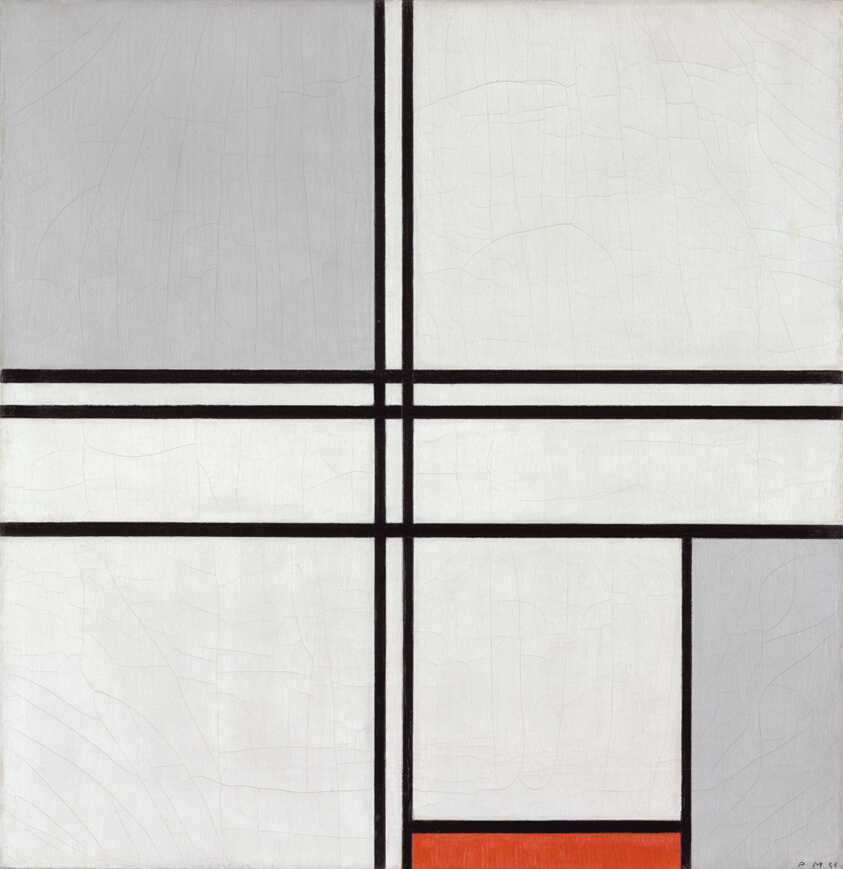 Piet Mondrian, "Composition (No. 1) Gray-Red" — the grid of black lines and primary-color planes that defined an entire movement's visual vocabulary. (Art Institute of Chicago, CC0 / Public Domain)
But De Stijl was never just a painting movement. Theo van Doesburg insisted that the same principles governing a Mondrian canvas should govern a chair, a typeface, and ultimately an entire city. The group designed furniture, typography, and most consequentially, buildings. Rietveld's Schroder House in Utrecht became the paradigmatic masterpiece of this ambition.
"De Stijl's leading architect Gerrit Thomas Rietveld (1888-1964) completed in the early 1920s his paradigmatic masterpiece, the Schroder House in Utrecht. This small semi-detached suburban villa foreshadowed all the features which were to distinguish the style advocated at the Bauhaus and later throughout Europe and America, where it was to be called the International Style — asymmetrical composition, unrelieved cubic shapes of clean-cut precision, slab roofs often cantilevered out at the corners, large windows in continuous horizontal strips, a complete absence of moldings and other ornamentation." -- History of Art, p. 602
This architectural DNA is what makes De Stijl such a powerful style transfer source for building photographs. The movement's visual vocabulary — primary colors, right angles, asymmetric balance, grid structure — maps directly onto the geometric language architects use every day. When a neural network applies De Stijl style transfer to an architecture photograph, it is revealing the latent Mondrian that already lives in the structure of every well-designed building.
Why De Stijl Works for Architecture Photos
Architecture is listed as De Stijl's best content type, and the technical explanation starts with frequency profile compatibility. De Stijl paintings operate at very low frequency with rigid grid structure — broad planes of flat color separated by precise black lines. Architecture photographs are dominated by high-frequency geometric edges: sharp lines of steel beams, repetitive window grids, straight verticals and long horizontals. This is actually an ideal complementary pairing. The neural network does not need to invent geometric structure — every building provides an abundance of edges and patterns that serve as natural anchors for the grid-based transformation. The task is translating one geometric language into another, not imposing geometry onto chaos.
"Members of the group designed furniture, household articles, typography, and industrial objects in the same spirit of strict simplicity and geometrical order. Certain aspects of De Stijl design affected modern art elsewhere, most noticeably through the influence of Mondrian and Van Doesburg at the Bauhaus in Dessau, Germany." -- Art Through the Ages, p. 739
The LPIPS of 0.345 demonstrates strong content preservation — the building's proportions and spatial relationships survive clearly. The FID of 121.51 confirms robust style fidelity: Mondrian's primary colors assert themselves in the facade, black grid lines emerge along structural elements, and the asymmetric balance that distinguishes real De Stijl work from mere geometric abstraction is unmistakable. For a ranked comparison, see our Best Art Styles for Architecture guide.
ArtFID Quality Score: Architecture + De Stijl
ArtFID (Artistic Frechet Inception Distance) combines two metrics: LPIPS measures content preservation, FID measures style fidelity. ArtFID = (1 + LPIPS) x (1 + FID). Lower = better.
| Content Type | ArtFID | Stars | Verdict |
|---|---|---|---|
| Fantasy | 106.81 | 5 | Outstanding — imaginative scenes respond brilliantly to geometric abstraction |
| Still Life | 111.33 | 5 | Excellent — defined object boundaries align with grid logic |
| Travel | 159.04 | 5 | Strong — mixed architectural and cultural scenes translate well |
| Architecture | 164.79 | 5 | Excellent — the movement's best content type by heritage |
| Landscapes | 179.64 | 5 | Good — broad planes of sky and terrain suit low-frequency style |
| Street Scenes | 181.88 | 5 | Good — urban geometry provides structural anchors |
| Portraits | 198.89 | 5 | Decent — facial symmetry offers geometric footing |
| Flowers | 212.13 | 5 | Acceptable — organic curves resist strict grid logic |
| Food | 217.20 | 5 | Acceptable — irregular shapes challenge angular vocabulary |
| Vehicles | 225.97 | 5 | Fair — curved bodywork resists rectilinear structure |
| Interiors | 233.07 | 5 | Fair — domestic spaces lack the scale of exteriors |
| Night Scenes | 237.26 | 5 | Fair — low contrast can obscure clean grid lines |
| Seascapes | 238.01 | 5 | Challenging — waves are inherently anti-grid |
| Animals | 260.94 | 5 | Difficult — organic forms resist angular vocabulary |
| Urban Scenes | 275.70 | 5 | Difficult — visual clutter overwhelms minimal grid |
Architecture score: 164.79 (LPIPS = 0.345, FID = 121.51) — Architecture ranks 4th overall, trailing only Fantasy, Still Life, and Travel. Given that De Stijl was literally founded by architects and painters working in tandem, this top-tier placement confirms what a century of art history established: the movement's visual language and architectural photography share the same geometric DNA. The full De Stijl style transfer analysis covers all 15 content types.
Before & After: Architecture in De Stijl Style
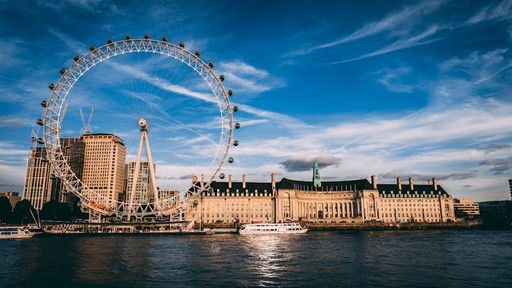
Every row below shows three images: the original photograph, a De Stijl painting used as the style reference, and the AI-generated result.
Architecture — 5 Stars (ArtFID 164.79)
The building's structural grid becomes the canvas grid; the window pattern becomes a Mondrian color composition; vertical and horizontal lines map directly onto De Stijl's strict orthogonal vocabulary. The result is not a building with a filter — it is a building revealed as the abstract composition it always was.
| Original Photo | Style Reference | AI Result |
|---|---|---|
|
|
|
| Source photo | Mondrian, "Composition (No. 1) Gray-Red" (AIC, CC0) | ArtFID: 164.79 — 5 Stars |
LPIPS: 0.345 (content preservation) | FID: 121.51 (style fidelity)
The building's structural skeleton — columns, beams, window mullions, floor lines — has been absorbed into De Stijl's characteristic black grid. Where the original photograph showed concrete, glass, and steel, the output replaces those materials with flat, unmodulated color planes: rectangles of red, yellow, blue, and white bounded by resolute black lines. The building's proportions remain legible — you can still read the fenestration pattern, the floor count, the relationship between solid wall and glazed opening — but the surface has been rebuilt in Neo-Plasticism's vocabulary. This is what Rietveld aimed for with the Schroder House: a building that is simultaneously functional structure and abstract composition. The neural network achieves in seconds what De Stijl architects spent years theorizing — the total unification of pictorial and architectural space.
Photography Tips for Best De Stijl Results
-
Seek strong orthogonal compositions. Mondrian famously rejected diagonals (a disagreement over diagonal lines with Van Doesburg actually split the movement). Photograph buildings straight-on to emphasize the grid of windows, floors, and structural bays. Avoid dramatic perspective distortion that introduces converging lines.
-
Favor modernist and International Style buildings. Glass-and-steel curtain walls, Bauhaus-influenced facades, Brutalist grids, and minimalist contemporary architecture already speak a visual language close to De Stijl's own. Ornate Gothic or Baroque facades — with their curves and sculptural decoration — resist the grid transformation.
-
Shoot in even, overcast lighting. Harsh shadows create tonal contrasts the algorithm must balance against De Stijl's preference for flat color planes. Diffused illumination lets the neural network focus on structural geometry rather than light-and-shadow drama.
-
Include generous sky area. Mondrian's compositions frequently feature large white planes that provide breathing room around active colored rectangles. Sky in your photograph gives the algorithm open space to create those same restful counterbalances.
-
Isolate a single facade or structural bay. De Stijl's power comes from clarity and reduction. Rather than an entire street scene (275.70 ArtFID — the weakest De Stijl result), isolate a single building face or repetitive window pattern. Simpler geometry produces more powerful transformations.
How to Apply De Stijl Style (3 Steps)
Step 1: Choose Your Photo
Upload any architecture photograph to ArtRobot. Based on our ArtFID testing, architecture, travel scenes, and still life produce the best De Stijl results — but architecture is the content type the movement was built for.
Step 2: Select De Stijl Style
Choose from classic De Stijl paintings as the style reference, including Mondrian's iconic grid compositions from the Art Institute of Chicago. ArtRobot uses the ArtFlow algorithm (CVPR 2021), an invertible neural network that preserves your photo's architectural structure while transferring De Stijl's primary-color geometry and grid logic.
Step 3: Download Your Art
ArtRobot generates your De Stijl-style image in seconds. Download in multiple resolutions — from social media sizes to print-ready 4K. The result works as a striking architectural art print or a design element channeling the precision of Dutch modernism.
Try De Stijl Style Transfer Free on ArtRobot ->
FAQ
How does De Stijl style transfer work on architecture photos?
De Stijl style transfer uses a neural network trained on masterworks by Piet Mondrian and the broader De Stijl movement to re-render your architecture photograph in primary colors, black grid lines, and asymmetric rectangular compositions. The algorithm identifies geometric structures already present in the building — window grids, floor plates, structural bays — and translates them into the flat color planes and orthogonal lines that define Neo-Plasticism. The LPIPS of 0.345 confirms the building's structure remains fully legible through the transformation.
What ArtFID score does De Stijl get on architecture?
De Stijl achieves 164.79 ArtFID on architecture with a perfect 5-star rating, ranking 4th out of 15 content types tested. The LPIPS of 0.345 means the building remains structurally recognizable, while the FID of 121.51 confirms authentic De Stijl style fidelity — the output genuinely reads as a Neo-Plastic composition rather than a generic geometric filter.
Is De Stijl a good choice for architecture photography?
It is arguably the best possible choice. Architecture is De Stijl's designated best content type — rooted in the movement's own history, where architects like Rietveld and painters like Mondrian developed a unified visual language for both canvas and building. The 164.79 ArtFID with 5-star rating confirms this century-old artistic partnership translates perfectly into neural style transfer. For a full comparison, see Best Art Styles for Architecture.
What architecture photo tips improve De Stijl results?
Photograph buildings straight-on to emphasize orthogonal grids rather than introducing perspective distortion. Favor modernist architecture with clean lines and repetitive geometric patterns. Shoot in overcast light for even illumination. Include generous sky area for color composition space. Isolate a single facade rather than complex multi-building scenes — De Stijl's power comes from clarity and geometric reduction.
Can I try De Stijl architecture style transfer for free?
Yes. ArtRobot provides free credits to every new user, so you can upload an architecture photograph and apply De Stijl style transfer without any payment. Visit ArtRobot.ai to start immediately. The style references include Mondrian masterworks from the Art Institute of Chicago's open-access collection.
Related Architecture Styles
Explore more art styles for architecture photography:
- Architecture Style Transfer Guide — comprehensive comparison of all art styles tested on architectural photography
- De Stijl Style Transfer — De Stijl performance across all 15 content types
- Best Art Styles for Architecture — top-performing styles ranked by ArtFID score
- Piet Mondrian Style Transfer — Mondrian's work as a style transfer source across all content categories
Try It Yourself
De Stijl earned 5 stars on architecture with a 164.79 ArtFID — confirming what Mondrian, Van Doesburg, and Rietveld spent their careers demonstrating: that a grid of primary colors on a flat plane and a grid of windows on a building facade are two expressions of the same underlying geometric order. A neural network trained on Mondrian's compositions does not bridge a gap between art and building — it dissolves the distinction entirely, revealing the Neo-Plastic composition latent in every structure's bones. Upload your architecture photo to ArtRobot's De Stijl style transfer and discover what Rietveld already knew: every building is a Mondrian, if you know how to look. Free credits included.
Try It Yourself
Transform your own photos into stunning paintings with 80+ artist styles. Free to start.