
AI Artist & Tech Enthusiast
Architecture Abstract Expressionism Photo Effect — AI Art...

Photo + Style = Your Artwork
This guide uses Mark Rothko - No. 61 (Rust and Blue). Select it automatically in the creator.
Architecture and Abstract Expressionism share an obsession with structure -- but they pursue it in opposite directions. Architecture builds structure up; Abstract Expressionism tears it down. The architecture abstract expressionism photo effect creates a collision between these two impulses that produces results unlike any other pairing in our library. Our ArtFID testing gives this combination 340.27 (4 stars), placing architecture 5th out of 15 content types -- notably, architecture is listed among Abstract Expressionism's two best content types alongside landscapes. For the full architecture style comparison, see the Architecture Style Transfer Guide.
Architecture — Van Gogh Style Transfer
About Abstract Expressionism Art Style
Abstract Expressionism (1940s-1960s) was born in New York from a generation of painters who rejected both European tradition and American regionalism. They sought to create art that existed as a direct record of the creative act itself -- not a picture of something, but a thing in itself.
"Analyzing the situation, the critic and champion of the Abstract Expressionists, Clement Greenberg, ruminated on the various possibilities the future held for artists. After the 'turgidities of Abstract Expressionism', he wrote, what was needed was a more disciplined, formalist art, one which recognized and concentrated on essentials and, he went on, 'the irreducibility of pictorial art consists in but two constitutive conventions or norms, flatness and the delimitation of flatness'." -- History of Art, p. 617
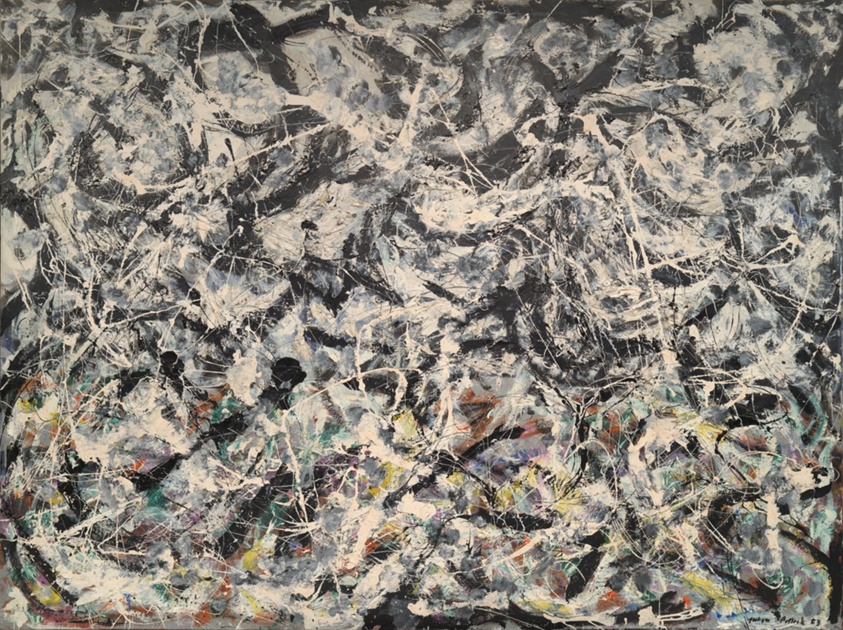 Jackson Pollock, "Greyed Rainbow" -- gestural energy dissolving all pictorial structure into pure visual experience. (Art Institute of Chicago, Museum Open Access)
The movement divided along a fundamental axis. Jackson Pollock's Action Painting treated the canvas as an arena for physical gesture -- dripping, pouring, and flinging paint in patterns that recorded his body's movement through space. Mark Rothko's Color Field painting pursued the opposite: luminous rectangles of color hovering on vast canvases, eliminating gesture entirely in favor of pure chromatic experience. Both shared the conviction that art should overwhelm the viewer through scale, intensity, and directness.
"The terms 'abstract Expressionist' (in New York) and 'action painting' (in London) suggest the artists' intention of projecting immediate emotional experience within the technique of abstract art. The premeditated structure of earlier abstract art, as it developed from Cubism, has been replaced by a handling of the medium which exploits, through dripping, spatters, and other accidental effects, the possibilities of emotional expression within the actual physical texture of the painted surface." -- Art Through the Ages, p. 757
For style transfer purposes, Abstract Expressionism's frequency profile ranges from low frequency (Rothko's blurred chromatic boundaries) to chaotic (Pollock's allover drip networks). Architecture's geometric precision sits at the opposite end of this spectrum -- and that productive tension is precisely what makes this pairing visually striking.
Why Abstract Expressionism Works for Architecture Photos
Architecture is the most structurally rigid content type in our library: straight lines, right angles, repetitive patterns, geometric precision. Abstract Expressionism is the most structurally liberated style: gestural chaos, dissolved edges, non-hierarchical surface energy. When the neural network forces these opposites together, the result is a creative destruction that neither could achieve alone.
The algorithm preserves architecture's fundamental geometry -- the building's silhouette, the rhythm of windows, the verticality of columns -- while dissolving surface precision into gestural energy. Pollock's drip technique replaces brick texture with tangled webs of color; Rothko's chromatic fields transform glass facades into luminous color planes. The building remains recognizably a building, but its surfaces vibrate with the physical urgency of paint applied at the scale of human gesture.
This pairing carries particular resonance because Abstract Expressionism emerged in New York, surrounded by architecture. Franz Kline's monumental black-and-white paintings have been compared to the steel girder structures of Manhattan bridges and skyscrapers. Willem de Kooning painted while looking out at lower Manhattan. The movement's monumental scale was itself architectural -- canvases so large they functioned as environments rather than objects.
The LPIPS of 0.6273 reflects the aggressive transformation: architectural detail is significantly reimagined. The FID of 208.1 confirms strong alignment with authentic Abstract Expressionist visual language. The 4-star rating places architecture comfortably above average, and its listing among the style's two best content types reflects the deep structural dialogue between architectural geometry and gestural abstraction.
ArtFID Quality Score: Architecture + Abstract Expressionism
ArtFID (Artistic Frechet Inception Distance) combines two metrics: LPIPS measures content preservation, FID measures style fidelity. ArtFID = (1 + LPIPS) x (1 + FID). Lower = better.
| Content Type | ArtFID | Stars | Verdict |
|---|---|---|---|
| Animals | 212.17 | 5 | Excellent -- organic forms become gestural energy |
| Fantasy | 296.46 | 5 | Excellent -- imaginative content embraces abstraction |
| Street Scenes | 327.74 | 4 | Strong -- urban complexity channels Pollock's density |
| Landscapes | 333.69 | 4 | Strong -- horizon and sky map to Rothko's color fields |
| Architecture | 340.27 | 4 | Strong -- geometric structure anchors gestural chaos |
| Flowers | 342.01 | 4 | Good -- organic curves absorb chromatic transformation |
| Night Scenes | 342.43 | 4 | Good -- darkness intensifies Rothko-like luminosity |
| Food | 367.48 | 3 | Fair -- defined objects resist complete abstraction |
| Seascapes | 373.16 | 3 | Fair -- water surfaces compete with drip textures |
| Urban Scenes | 374.97 | 3 | Fair -- dense detail overwhelms gestural clarity |
| Interiors | 378.95 | 3 | Fair -- confined spaces limit monumental scale effect |
| Portraits | 401.34 | 2 | Challenging -- facial identity conflicts with abstraction |
| Travel | 429.24 | 2 | Challenging -- cultural specificity resists universalism |
| Vehicles | 433.34 | 2 | Challenging -- mechanical precision opposes gestural freedom |
| Still Life | 454.15 | 2 | Challenging -- defined objects resist dissolution |
Architecture score: 340.27 (LPIPS = 0.6273, FID = 208.1) -- Architecture ranks 5th out of 15 content types with a solid 4-star rating. The LPIPS of 0.6273 means the building's essential geometry survives -- you will recognize the structure -- but surface detail undergoes radical transformation. Window grids become Pollock-like webs; facade textures dissolve into chromatic fields. The FID of 208.1 confirms the output reads as genuine Abstract Expressionist visual language rather than random distortion.
Before & After: Architecture in Abstract Expressionism Style
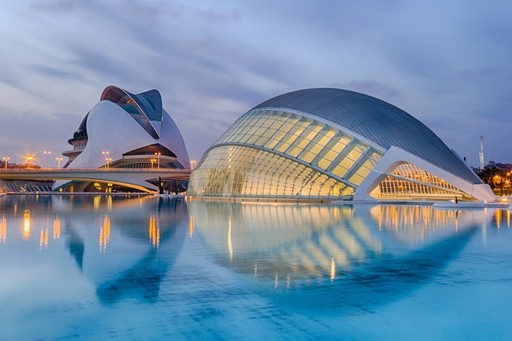
Every row below shows three images: the original photograph, an Abstract Expressionism painting used as the style reference, and the AI-generated result.
Architecture -- 4 Stars (ArtFID 340.27)
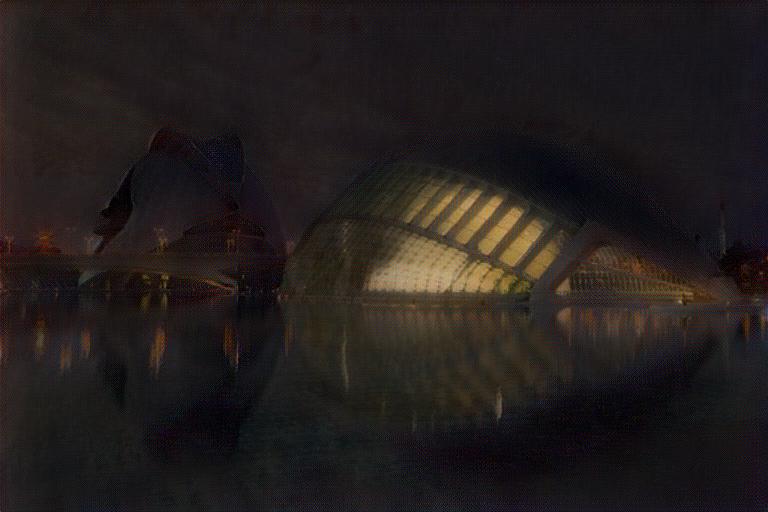
The building's silhouette and proportions survive while every surface transforms. Brick becomes gestural texture; glass becomes luminous color field; sky becomes Pollock's dripped atmosphere. The result sits in a productive tension between architectural order and painterly chaos -- exactly the tension that defined the New York art world in the 1950s.
| Original Photo | Style Reference | AI Result |
|---|---|---|
|
|
|
| Source photo | Pollock, "Greyed Rainbow" (AIC, Museum Open Access) | ArtFID: 340.27 -- 4 Stars |
LPIPS: 0.6273 (content preservation) | FID: 208.1 (style fidelity)
Notice how the building retains its structural skeleton -- vertical and horizontal divisions, window rhythm, roofline profile -- while every surface acquires the physical texture of paint. The sky does not simply change color; it gains the layered density of Pollock's dripped surfaces. This is architecture reimagined as a record of physical gesture rather than geometric planning.
Photography Tips for Best Abstract Expressionism Results
Abstract Expressionism already scores 4 stars on architecture, but the right source photograph amplifies the dramatic collision between geometric order and gestural chaos.
-
Photograph buildings with strong geometric silhouettes. Abstract Expressionism's gestural energy needs structural opposition to create visual tension. Buildings with clear rectangular profiles, prominent window grids, or rhythmic column spacing provide the geometric framework that anchors the chaos. A building with an ambiguous silhouette produces ambiguous results; a building with bold geometry produces a powerful dialogue between order and entropy.
-
Seek monumental scale in your subject. Abstract Expressionism was itself defined by monumental scale -- paintings that filled entire walls. Photographs of large-scale architecture (skyscrapers, cathedrals, bridges, industrial structures) resonate with the movement's ambition to overwhelm the viewer. A garden shed will not produce the same impact as a suspension bridge.
-
Shoot in dramatic lighting conditions. The Abstract Expressionists worked in New York -- a city of extreme light contrasts. Late afternoon sun creating hard shadows across facades, storm light splitting a building between illumination and darkness, neon glow on wet nighttime surfaces -- these conditions provide the tonal drama that the algorithm translates into painterly intensity.
-
Include sky as negative space. Pollock's paintings have no negative space -- energy fills every corner. But your architecture photograph benefits from substantial sky area, which the algorithm transforms into its own Abstract Expressionist surface. The contrast between the building's transformed geometry and the sky's transformed atmosphere creates visual depth that pure building-fill compositions lack.
-
Experiment with different Pollock works as reference. "Greyed Rainbow" produces muted, earthy gestural energy. "The Key" produces more aggressive chromatic chaos. The same building will look dramatically different depending on which Pollock painting drives the style transfer. Try multiple references to find the match that serves your architectural subject best.
How to Apply Abstract Expressionism Style (3 Steps)
Step 1: Choose Your Photo
Upload any architecture photograph to ArtRobot. Based on our ArtFID testing, architecture ranks among Abstract Expressionism's two best content types alongside landscapes. Favor buildings with strong geometric profiles and dramatic lighting.
Step 2: Select Abstract Expressionism Style
Choose from masterworks by Jackson Pollock or Mark Rothko as your style reference. ArtRobot uses the ArtFlow algorithm (CVPR 2021), an invertible neural network that preserves your building's structural geometry while transferring Abstract Expressionism's gestural energy, chromatic intensity, and physical texture.
Step 3: Download Your Art
ArtRobot generates your Abstract Expressionism-style architecture image in seconds. Download in multiple resolutions -- from social media sizes to print-ready 4K. The result works as contemporary wall art, an architectural statement piece, or a social media image that transforms familiar buildings into visual events.
Try Abstract Expressionism Style Transfer Free on ArtRobot ->
FAQ
How does Abstract Expressionism style transfer work on architecture photos?
The algorithm extracts statistical texture patterns (Gram matrices) from Abstract Expressionist reference paintings -- works by Jackson Pollock and Mark Rothko -- and applies them to your architecture photograph. It preserves the building's structural geometry (silhouette, window rhythm, proportions) while transforming surface textures into gestural brushwork or chromatic fields. The productive tension between architectural precision and painterly chaos is what gives this pairing its distinctive visual power.
What ArtFID score does Abstract Expressionism get on architecture?
Abstract Expressionism achieves 340.27 ArtFID on architecture with a 4-star rating, ranking 5th out of 15 content types. Architecture is listed among the style's two best content types alongside landscapes. The LPIPS of 0.6273 reflects the radical nature of the transformation -- surfaces are aggressively reimagined -- while the FID of 208.1 confirms the output reads as genuine Abstract Expressionist visual language.
Is Abstract Expressionism a good choice for architecture photography?
Abstract Expressionism is an excellent choice for architecture that demands bold visual transformation. The pairing creates a unique collision between geometric order and gestural chaos that produces results unlike any other style in our library. Architecture provides the structural anchors that prevent the gestural energy from dissolving into formlessness, while Abstract Expressionism's aggressive surface transformation prevents the architecture from remaining merely photographic. For comprehensive comparison, see Best Art Styles for Architecture.
What architecture photo tips improve Abstract Expressionism results?
Photograph buildings with strong geometric silhouettes that provide clear structural opposition to gestural chaos. Seek monumental scale -- skyscrapers, cathedrals, bridges -- that resonates with the movement's own monumental ambition. Shoot in dramatic lighting (late afternoon, storm light, neon) for tonal intensity. Include substantial sky area as compositional negative space. Experiment with different Pollock reference paintings for dramatically different results from the same building.
Can I try Abstract Expressionism architecture style transfer for free?
Yes. Visit ArtRobot to upload an architecture photograph and apply Abstract Expressionism style transfer at no cost. Choose from multiple reference paintings including Jackson Pollock's masterworks from the Art Institute of Chicago's collection. The algorithm is the same ArtFlow neural network (CVPR 2021) used in our ArtFID benchmark testing.
Related Architecture Styles
Explore more art styles for architecture photography:
- Architecture Style Transfer Guide -- comprehensive comparison of all art styles tested on architecture photography
- Abstract Expressionism Style Transfer -- Abstract Expressionism performance across all 15 content types
- Best Art Styles for Architecture -- top-performing styles ranked by ArtFID score
- Jackson Pollock Style Transfer -- the Action Painter whose drip technique dissolved representation into pure gesture
- Mark Rothko Style Transfer -- the Color Field painter whose luminous rectangles transform surfaces into chromatic experience
Try It Yourself
Abstract Expressionism and architecture share a common ancestor: the ambition to create environments that overwhelm the viewer through scale, structure, and intensity. Pollock's studio floor was his canvas -- an architectural surface transformed by gesture. Your building photograph is the reverse: an architectural surface that the neural network transforms through Pollock's gestural vocabulary. At 340.27 and 4 stars, architecture ranks among Abstract Expressionism's strongest pairings. Upload your building to ArtRobot's Abstract Expressionism style transfer and discover what happens when the most structured content type meets the most liberated style. Free credits included.
Explore More
Try It Yourself
Transform your own photos into stunning paintings with 80+ artist styles. Free to start.